Ad Creatives to ROI: The Complete Cross-Platform Tracking Guide
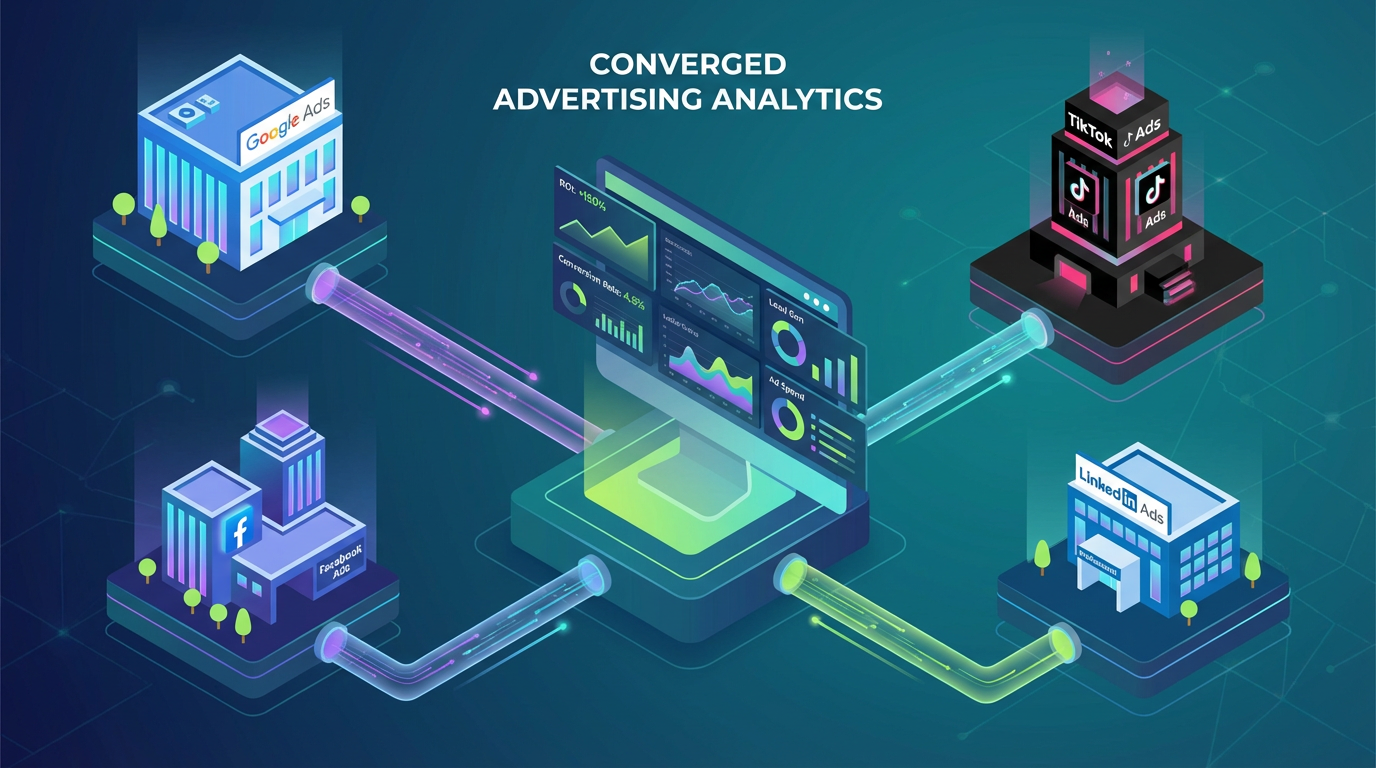
You're running ads on Meta, Google, TikTok, and LinkedIn simultaneously. Each platform reports different numbers. None of them match your actual revenue.
Sound familiar?
The problem isn't your campaigns—it's your tracking infrastructure. And it's costing you more than you realize.
Why Cross-Platform Tracking Breaks Down
Every advertising platform wants credit for the conversion. Meta claims the sale happened because someone saw your Instagram ad three days ago. Google says it was the search ad they clicked yesterday. LinkedIn insists their sponsored content started the journey two weeks back.
They're all technically correct. But they're also all wrong.
This overlap—called attribution conflict—inflates your reported conversions by 40-60% on average. You think you're getting 100 conversions when you're actually getting 65. Your cost per acquisition looks great in each platform's dashboard, but your bank account tells a different story.
The solution requires three layers: proper pixel implementation, unified tracking architecture, and a single source of truth for revenue data.
Platform-Specific Creative Requirements (And Why They Matter for Tracking)
Before you can track performance accurately, you need creatives that actually perform on each platform. This isn't about aesthetics—it's about technical specifications that determine whether your ads even get delivered properly.
Meta (Facebook and Instagram) requires 1:1 square format for feed ads, but 9:16 vertical for Stories and Reels. Video length caps at 241 minutes technically, but engagement drops 65% after 15 seconds. Your tracking pixel fires on specific actions—but if your creative doesn't stop the scroll in 1.7 seconds (the average decision time), that pixel never gets the chance to collect data.
Google Display ads need responsive formats: upload 15 images, 5 headlines, and 4 descriptions minimum. Google's machine learning tests combinations, but here's what they don't tell you: ads with all asset slots filled get 12% more impressions and 8% better conversion rates. That directly impacts your tracking volume and statistical significance.
TikTok demands vertical video (9:16 ratio) between 9-15 seconds for optimal performance. Anything longer sees completion rates drop by 34%. Since TikTok's pixel tracks video views at 25%, 50%, 75%, and 100% completion, longer videos mean incomplete tracking data. You're making decisions based on partial information.
LinkedIn responds to document ads and carousel formats that other platforms ignore. Their audience expects professional, data-driven content—which means your creative directly influences the quality of traffic hitting your tracking pixels. Better creative quality correlates with 23-31% higher conversion rates, giving you cleaner attribution data.
Tracking Pixel Implementation: The Technical Foundation
Your tracking infrastructure starts with pixels—small pieces of code that fire when users take specific actions. But most marketers implement them wrong.
The Meta Pixel needs to be installed in your website's header section, above the closing </head> tag. It should fire a PageView event on every page load, then custom events for ViewContent, AddToCart, InitiateCheckout, and Purchase. Each event needs parameters: content_name, content_ids, content_type, value, and currency.
Why this level of detail? Because Meta's algorithm optimizes based on the data you send back. If you only track purchases without values, Meta can't distinguish between a $50 sale and a $5,000 sale. Your optimization suffers, your costs increase, and your ROI calculations become meaningless.
Google's Global Site Tag (gtag.js) works differently. Install it site-wide, then add conversion tracking tags for specific actions. Google recommends using Google Tag Manager instead of hardcoding tags—it allows you to deploy, modify, and troubleshoot tracking without developer help. This matters because the average marketer needs to adjust tracking parameters 8-12 times during a campaign's first month.
TikTok Pixel installation mirrors Meta's approach but requires additional setup for iOS 14+ users due to Apple's App Tracking Transparency framework. You'll need to configure Aggregated Event Measurement and prioritize your conversion events—TikTok allows only 8 events per domain. Choose wisely: most advertisers prioritize Purchase, CompleteRegistration, and AddToCart.
LinkedIn Insight Tag tracks conversions differently because their audience behaves differently. B2B sales cycles average 3-6 months with 7-13 touchpoints. LinkedIn's tag needs to fire on micro-conversions: whitepaper downloads, demo requests, newsletter signups. These early-funnel actions provide the data LinkedIn needs to optimize, even though the actual sale happens weeks later through direct sales calls.
Native Analytics: What Each Platform Actually Tells You
Every platform provides its own analytics dashboard. None of them tell the complete story.
Meta Ads Manager shows you frequency (how many times people see your ads), relevance score, and cost per result. But "result" means different things for different campaign objectives—it might be a link click, a landing page view, or a purchase. Meta also reports on estimated ad recall lift and quality ranking compared to competing ads. These metrics help you understand creative performance, but they're useless for calculating actual ROI.
Google Ads provides search term reports (which queries triggered your ads), quality scores (1-10 rating based on expected CTR, ad relevance, and landing page experience), and auction insights (how you compare to competitors). Quality score directly impacts your costs—improving from 5 to 8 can reduce your CPC by 30-40%. But Google's conversion tracking only captures what happens after the click. If someone searches, clicks, leaves, then returns directly to purchase, Google takes full credit.
TikTok Analytics emphasizes engagement metrics: average watch time, traffic source types, and follower activity patterns. Their Creative Center shows trending hashtags, top ads, and viral content in your industry. This helps you create better ads but doesn't solve attribution. TikTok's conversion window defaults to 7 days, meaning any purchase within a week of clicking your ad gets attributed to TikTok—even if the user clicked five other ads from different platforms in between.
LinkedIn Campaign Manager focuses on demographic data: job titles, company sizes, industries, and seniority levels of people engaging with your ads. For B2B marketers, this is gold—you can see if you're actually reaching decision-makers or wasting budget on junior employees. But LinkedIn's last-touch attribution model gives them credit for any conversion where they were the last ad clicked before purchase.
The pattern? Each platform optimizes for its own metrics and takes credit wherever possible.
Calculating True ROI: Beyond Platform Dashboards
Real ROI calculation requires connecting ad spend to actual revenue—not reported conversions.
Start with your source of truth: your CRM, payment processor, or e-commerce platform. Shopify, Stripe, HubSpot, Salesforce—wherever your money actually lands. This becomes your baseline for revenue data.
Then implement UTM parameters on every single ad link. Structure them consistently:
- utm_source: the platform (facebook, google, tiktok, linkedin)
- utm_medium: the ad type (cpc, cpm, sponsored)
- utm_campaign: your campaign name
- utm_content: the specific ad variation
- utm_term: keywords (for search ads)
UTM parameters pass through to your analytics platform (Google Analytics, Adobe Analytics, or Mixpanel) and should sync with your CRM. This creates a thread connecting the ad someone clicked to the revenue they generated.
But UTMs alone aren't enough because of multi-touch attribution. Someone might click your TikTok ad on Monday, your Google ad on Wednesday, and your Meta ad on Friday before purchasing. Which ad deserves credit?
First-touch attribution gives all credit to TikTok (the first interaction). Last-touch attribution gives it all to Meta (the final click). Linear attribution splits credit equally among all three. Time-decay attribution gives more credit to recent interactions.
The right model depends on your business. E-commerce with short sales cycles (1-3 days) can use last-touch attribution—the final ad probably did trigger the purchase. B2B with long cycles (60-180 days) needs multi-touch modeling because early awareness ads matter as much as final retargeting.
For most businesses, a position-based model works best: 40% credit to the first touch, 40% to the last touch, and 20% split among middle interactions. This acknowledges that both awareness and conversion ads matter.
Calculate your true ROI using this formula: (Revenue from attributed conversions - Total ad spend) / Total ad spend × 100
If you spent $10,000 across all platforms and generated $35,000 in attributed revenue, your ROI is 250%. But verify those attributed conversions against your actual revenue. If platforms report 200 conversions worth $35,000 but you only received $25,000, your real ROI is 150%—still profitable, but 40% lower than you thought.
Consolidating Multi-Platform Data: Your Single Source of Truth
You need one place where all your advertising data lives, properly deduplicated and normalized. This is your single source of truth for making budget decisions.
Google Analytics 4 is the free option. With proper UTM tagging, GA4 can track all your traffic sources and conversions in one place. Set up custom dimensions for platform, campaign, and ad variation. Create custom reports that show cost data (imported from each platform) alongside conversion data. The limitation: you're manually stitching data together from multiple sources.
Dedicated attribution platforms like Hyros, TripleWhale, or Northbeam ($500-2,000/month) automate this process. They connect directly to your ad accounts, pull spend and performance data, match it with your actual sales, and handle deduplication automatically. For businesses spending $50,000+/month on ads, these platforms typically pay for themselves by identifying 10-20% budget waste within the first month.
The key is consistency. Choose one system, implement it completely, and give it 30 days of clean data before making major decisions. Switching attribution systems every month creates more confusion than clarity.
Related Guides: Tracking Setup Guide, UTM Builder, Platform Comparison Guide.