If you've spent any time planning a display advertising campaign, you've encountered the question: Google Display Network or programmatic? Many advertisers treat these as competing options on the same level. They're not. One is a platform. The other is a buying method. Understanding the distinction matters more than any cost comparison you'll run.
This guide cuts through the confusion with current cost data (Q2 2026), an honest inventory comparison, and a decision framework based on your budget and goals—not generalizations.
GDN and Programmatic: What's Actually Different
The most common mistake advertisers make is treating Google Display Network (GDN) and programmatic display as two separate platforms competing for the same inventory. They're structured differently at a fundamental level.
What Google Display Network Actually Is
GDN is Google's own advertising network, accessed exclusively through Google Ads. When you run a display campaign in Google Ads, you're buying placements on:
- Websites that have signed up for Google AdSense (over 2 million publisher sites)
- Google-owned properties including Gmail and YouTube
- Google's partner apps in the Google Play ecosystem
GDN is a closed network. You access it through Google Ads, you use Google's audience data, and you're bidding within Google's auction system. It's self-contained, tightly integrated with your Google campaign data, and relatively simple to operate.
What Programmatic Display Actually Is
Programmatic is not a platform—it's a buying method. Programmatic display means using automated technology (a Demand-Side Platform, or DSP) to bid in real time across multiple ad exchanges simultaneously. Those exchanges include:
- Google's Ad Exchange (Google Ads Exchange / AdX)
- OpenX, Rubicon, PubMatic, and other open exchanges
- Private marketplaces (PMPs) operated by premium publishers
- Programmatic guaranteed deals with specific publishers
Popular DSPs used for programmatic buying include Google's own DV360 (Display & Video 360), The Trade Desk, Amazon DSP, and MediaMath. These platforms let you buy across all of the above exchanges from a single interface.
The critical point: programmatic buying can include Google's inventory. GDN is a subset of the total programmatic ecosystem. When you run programmatic campaigns through DV360, you can bid on the same Google AdSense inventory available in GDN—plus a much wider universe of inventory outside it.
Why the Confusion Persists
Google's marketing doesn't help clarify this. DV360 is positioned as the "enterprise" option and GDN as the "accessible" option, creating a false impression that they serve different audiences when they actually provide different levels of access to overlapping inventory pools. The practical differences come down to control, reach, and the sophistication of your campaign operations.
Cost Comparison: CPM and CPC Side by Side
Here's where the numbers often surprise advertisers: GDN and programmatic display have similar headline costs. The difference isn't primarily in CPM or CPC—it's in what you get for that spend.
Current Display Advertising Benchmarks (Q2 2026)
| Platform / Method | Average CPM | Average CPC | Inventory Type |
|---|---|---|---|
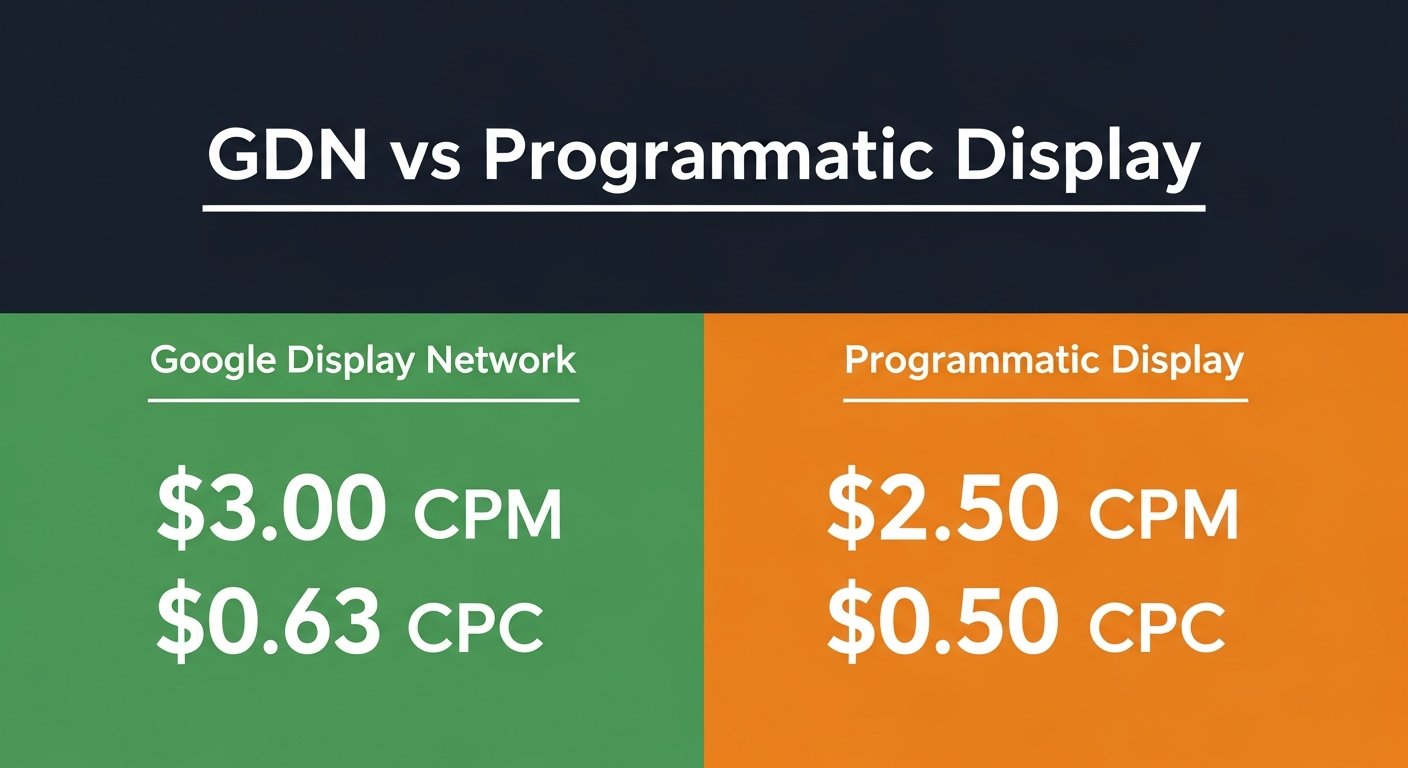
| Google Display Network (GDN) | $3.00 | $0.63 | Google-owned exchanges and AdSense |
| Programmatic Display | $2.50 | $0.50 | Multi-exchange, open and private markets |
| Meta (Facebook/Instagram) | $13.50 | — | Social feed and stories |
| TikTok | $5.50 | — | Video/social |
| $33.80 | — | Professional/B2B |
At $3.00 CPM, GDN is slightly more expensive than programmatic's $2.50 CPM—a 20% premium. For every 100,000 impressions, you're paying $300 via GDN versus $250 programmatically. At scale, that difference compounds, but for most SMB budgets, the cost gap isn't the deciding factor.
The context column in the table above matters more than the CPM column. Meta at $13.50 CPM is 4.5x more expensive than GDN—but you're reaching logged-in users with rich behavioral and interest targeting that display simply can't match. LinkedIn at $33.80 CPM is 11x more expensive than programmatic—but that premium buys access to professional targeting by job title, company size, and industry that doesn't exist in display at any price.
Display (both GDN and programmatic) is the right choice when you need scale at low cost-per-impression—not when you need the precision targeting of social platforms. Use our CPM Calculator to model reach at these rates for your specific budget.
What Drives Cost Differences Within Each Channel
Both GDN and programmatic CPMs vary significantly based on:
- Ad format: Standard banner formats (300x250, 728x90) are cheapest. Rich media, video pre-roll, and high-impact formats command significant premiums
- Audience targeting: Contextual targeting and broad reach deliver lower CPMs than behavioral, retargeting, or custom audience segments
- Publisher quality: Run-of-network (RON) placements average $2-3 CPM; premium publisher direct buys can reach $10-20+ CPM
- Vertical: Finance, legal, healthcare, and technology inventory costs 50-200% more than general interest content
- Geography: US targeting costs 3-5x more than emerging markets
Inventory and Reach: Where Your Ads Actually Appear
Scale and placement quality are where GDN and programmatic diverge most significantly.
GDN Inventory
GDN reaches approximately 90% of internet users globally, according to Google's figures—a claim that reflects the breadth of the AdSense publisher network rather than unique users reached in any given campaign. In practice, your GDN campaign will serve across a mix of:
- Mid-tier content sites monetized through AdSense
- Niche blogs and specialty publishers
- News and media sites in Google's network
- Gmail sponsored promotions (native email placements)
- YouTube display placements (banners and overlay ads alongside video)
GDN excludes premium publishers who sell inventory directly or through invitation-only programmatic deals. The New York Times, Wall Street Journal, major sports properties, and other top-tier publishers generally limit or restrict their GDN inventory, preferring to monetize through direct relationships or selective programmatic channels.
Programmatic Inventory
Programmatic buying through a full-featured DSP unlocks a wider inventory universe:
- Open exchange: Everything available in GDN, plus inventory from non-Google exchanges
- Private marketplaces (PMPs): Curated inventory from premium publishers, available by invitation or deal
- Programmatic guaranteed: Reserved inventory at negotiated CPMs—you get the reach guarantee of a traditional media buy with programmatic targeting and measurement
- Connected TV (CTV): Streaming video inventory on Hulu, Peacock, Pluto TV, and others—accessible through major DSPs but not through GDN
- Digital out-of-home (DOOH): Programmatic-enabled billboard and transit screens, available through platforms like The Trade Desk
If your campaign requires premium publisher placements, CTV inventory, or inventory outside Google's ecosystem, GDN cannot deliver it. Programmatic is not just a different way to buy the same inventory—it's access to a materially different and larger inventory pool.
Targeting Capabilities Compared
Both channels offer display advertising's core targeting methods, but with meaningful differences in data access and cross-platform flexibility.
GDN Targeting
| Targeting Type | GDN Capability |
|---|---|
| Keyword contextual | Strong — Google's content classification is best in class |
| Topic/interest targeting | Strong — powered by Google's search and browse data |
| In-market audiences | Strong — Google's purchase intent signals from search activity |
| Remarketing / RLSA | Strong — seamless integration with Google Analytics and Google Ads audiences |
| Customer match | Available — upload email lists to target existing customers |
| Similar audiences | Available — Google's lookalike modeling |
| Third-party data segments | Limited — primarily Google's own data; limited third-party DMP integration |
| Cross-exchange frequency control | Not available — frequency capping only within GDN |
Programmatic Targeting
| Targeting Type | Programmatic Capability |
|---|---|
| Contextual targeting | Strong — multiple contextual vendors available (IAS, Oracle, DoubleVerify) |
| Third-party data segments | Extensive — access to Acxiom, Oracle Data Cloud, Nielsen, Experian, and hundreds of other DMP data providers |
| First-party data activation | Strong — direct DMP or CDP integration, onboarded data, lookalike modeling against your segments |
| Cross-exchange frequency control | Available — manage total frequency across all exchanges from one platform |
| Advanced attribution | Strong — multi-touch attribution models, view-through tracking across publishers |
| Deal targeting (PMPs) | Available — target specific premium publisher environments |
GDN's targeting advantage is Google's proprietary intent data—specifically in-market audiences derived from Google Search behavior. No programmatic DSP can replicate what Google knows from billions of search queries. If search intent is your primary targeting signal, GDN's data advantage is real.
Programmatic's targeting advantage is breadth and independence: access to hundreds of third-party data providers, the ability to bring your own data without being constrained to one platform's ecosystem, and unified frequency management across the entire campaign.
Brand Safety and Control
Brand safety is a legitimate concern in display advertising. Both channels have made significant improvements, but they differ in what controls are available and how they're enforced.
GDN Brand Safety Controls
GDN offers several built-in exclusion tools:
- Content exclusions: Exclude sensitive content categories (tragedy, violence, sexually suggestive content, etc.)
- Placement exclusions: Block specific websites, apps, or YouTube channels from serving your ads
- Placement reports: Review where your ads ran after the fact and exclude poor performers
- Digital content labels: Target by inventory quality tier (DL-G, DL-PG, DL-T, DL-MA)
GDN's brand safety advantage is Google's automated moderation of the AdSense publisher network. Publishers must meet Google's policies to participate, which provides a baseline quality floor that open programmatic exchanges don't enforce as consistently.
Programmatic Brand Safety Controls
Programmatic buying—especially through open exchanges—requires more active brand safety management:
- Third-party verification: Integrate IAS (Integral Ad Science), DoubleVerify, or MOAT for pre-bid and post-bid brand safety filtering
- Private marketplace deals: Buy from vetted publisher lists rather than open exchange, dramatically reducing brand safety risk
- Allowlists vs blocklists: Rather than blocking bad content after the fact, run allowlist-only campaigns that only serve on pre-approved domains
- Viewability floors: Set minimum viewability thresholds (typically 50% or 70% in-view) to reduce wasted spend on below-the-fold placements
A properly managed programmatic campaign with IAS or DoubleVerify pre-bid filtering and PMP deals can achieve brand safety standards equivalent to or better than GDN. The difference is effort: GDN has safety guardrails by default, while programmatic requires intentional setup. Unsophisticated programmatic campaigns without third-party verification are legitimately higher risk.
Performance by Use Case
Neither channel is universally better. Performance varies significantly by campaign objective.
Brand Awareness Campaigns
Programmatic advantage. When the goal is maximum reach at efficient CPM, programmatic's access to broader inventory, CTV placements, and premium publisher environments creates more brand-building opportunity. At $2.50 CPM versus $3.00 CPM, you get 20% more impressions per dollar—and with programmatic's frequency management, you can ensure those impressions are distributed across unique users rather than over-served to the same audience.
For large-scale awareness campaigns ($20,000+/month on display), programmatic's reach and frequency controls matter. For smaller budgets, the operational overhead of managing a DSP likely offsets the efficiency gains.
Remarketing Campaigns
GDN advantage for Google-first retargeting; programmatic advantage for cross-channel.
If your website traffic comes primarily from Google Search, GDN remarketing integrates directly with your Google Analytics audiences—no separate pixel, no audience sync delays, no data loss. For businesses running heavy Google Search campaigns, keeping remarketing within the Google ecosystem is often the simplest and most effective approach.
Programmatic retargeting makes more sense when you need to follow users across inventory outside Google's network, or when you want unified frequency management to prevent users from seeing your retargeting ads 15 times in a day across different sites.
Conversion-Focused Campaigns
GDN advantage for most advertisers. Google's Smart Bidding—Target CPA and Target ROAS—applies Google's full machine learning stack to optimize for conversions across GDN inventory. For advertisers with sufficient conversion volume (50+ conversions per month), Smart Bidding in GDN often outperforms manual programmatic optimization at comparable budgets.
Programmatic conversion campaigns can match or exceed GDN performance, but they require more sophisticated setup: proper attribution modeling, audience segmentation, and bid strategy configuration. Without that expertise, the technical capability doesn't translate into better results.
Use our ROAS Calculator to set performance targets before choosing a channel—knowing your required ROAS threshold helps determine which approach can realistically hit your profitability floor.
B2B Lead Generation
Programmatic advantage for account-based targeting. Account-based marketing (ABM) requires serving ads specifically to employees at target companies. Programmatic DSPs, particularly The Trade Desk and DV360, offer more sophisticated IP targeting and account-level targeting capabilities than GDN's standard interface. If your B2B campaign needs to reach specific companies rather than broad professional audiences, programmatic is the more capable channel.
Note: for B2B campaigns where professional targeting is the primary signal, LinkedIn at $33.80 CPM still often outperforms display at $2.50-$3.00 CPM despite the 11x cost difference—because the conversion rates from properly targeted LinkedIn traffic can be 3-5x higher. Model this before defaulting to the cheaper channel.
Which to Choose: Decision Framework
Here's the practical framework based on budget, team capability, and campaign objectives:
| Your Situation | Recommended Approach | Reasoning |
|---|---|---|
| Display budget under $10,000/month | GDN | Programmatic DSP fees and minimum spends typically require $15,000–$30,000/month to be cost-effective. Below that threshold, GDN delivers better net reach per dollar. |
| Display budget $10,000–$50,000/month | GDN with optional DV360 test | GDN handles this range well with Smart Bidding. If you have DSP access, test programmatic on 20–30% of budget to build comparison data. |
| Display budget $50,000+/month | Programmatic (DV360 or The Trade Desk) | At this scale, programmatic's frequency management, premium inventory access, and advanced audience capabilities deliver meaningful efficiency gains that justify the operational complexity. |
| In-house team of 1–2 marketers | GDN | Programmatic campaigns require ongoing DSP management, third-party verification setup, and deal curation. GDN's automated features work well with limited bandwidth. |
| Agency-managed or dedicated programmatic team | Programmatic | The operational overhead is absorbed by specialists; the campaign benefits from advanced targeting and inventory access. |
| Google Search is primary acquisition channel | GDN | Tight integration with Google Ads audiences, conversion data, and Smart Bidding creates efficiency advantages that offset programmatic's broader reach. |
| Need premium publisher placements or CTV | Programmatic | GDN cannot access premium PMPs or CTV inventory. Only programmatic DSPs provide this reach. |
| Brand safety is top priority and resources are limited | GDN | GDN's default publisher moderation reduces brand safety risk without requiring active management. Programmatic brand safety requires deliberate setup. |
| B2B account-based marketing (ABM) | Programmatic | DSPs like The Trade Desk offer company/IP-level targeting that GDN's standard interface doesn't match. |
| Remarketing to Google Search audiences | GDN | Native integration with Google Analytics remarketing lists; no data sync required. |
Running Both Channels
The question isn't always either/or. Many advertisers above $30,000/month in display spend benefit from running GDN and programmatic simultaneously with different objectives:
- GDN: Conversion-focused remarketing, Smart Bidding campaigns targeting Google Search visitors
- Programmatic: Broad awareness, premium publisher placements, CTV, audiences sourced from third-party data providers
When running both, set distinct KPIs for each channel rather than comparing them directly. GDN's conversion campaigns and programmatic's awareness campaigns serve different functions at different stages of the funnel. Use our Budget Allocator to model how to split display budget across channels based on your funnel objectives and current performance.
Getting Started with GDN
If you're starting with GDN:
- Enable auto-applied placement exclusions in your account settings to block low-quality inventory categories immediately
- Start with Smart Display campaigns using Target CPA bidding once you have 30+ monthly conversions
- Exclude mobile app inventory initially—app placements often deliver poor conversion quality for most advertisers
- Review your placement report weekly for the first 60 days and build an exclusion list
- Use responsive display ads rather than building individual banner sizes—Google's machine learning tests combinations at scale
Getting Started with Programmatic
If you're moving to programmatic:
- Choose a DSP based on your priorities: DV360 for Google ecosystem integration, The Trade Desk for independence and The Open Internet positioning, Amazon DSP for e-commerce and retail targeting
- Set up third-party brand safety verification (IAS or DoubleVerify) before activating campaigns
- Start with a curated allowlist of 200–500 approved domains rather than open exchange run-of-network
- Negotiate at least one PMP deal with a premium publisher in your vertical to establish a quality inventory baseline
- Define your frequency cap: a common starting point is 3 impressions per user per day, 10 per week
The Bottom Line
GDN and programmatic display serve overlapping but distinct needs. At $3.00 CPM and $0.63 CPC, GDN delivers solid reach with straightforward setup and Google's best-in-class intent data. At $2.50 CPM and $0.50 CPC, programmatic is marginally cheaper and significantly more powerful—but that power requires the budget, team, and infrastructure to use it correctly.
For most businesses running display advertising: start with GDN, optimize it thoroughly, and move to programmatic when your monthly display budget justifies the operational investment. The threshold is typically $30,000–$50,000 per month—below that, GDN's simplicity and Google's automation deliver competitive results without the complexity.
Don't upgrade to programmatic because it sounds more sophisticated. Upgrade when you've hit the ceiling of what GDN's targeting and inventory can deliver for your specific goals—when you need premium placements GDN can't access, frequency controls it can't provide, or third-party data it doesn't offer. That's the moment programmatic becomes worth the investment.
Related tools: Model your display reach at these CPM rates with our CPM Calculator, evaluate campaign profitability with our ROAS Calculator, and split your display budget across channels using our Budget Allocator.