Multi-Platform Budget Allocation: Strategic Framework for Meta, Google & TikTok
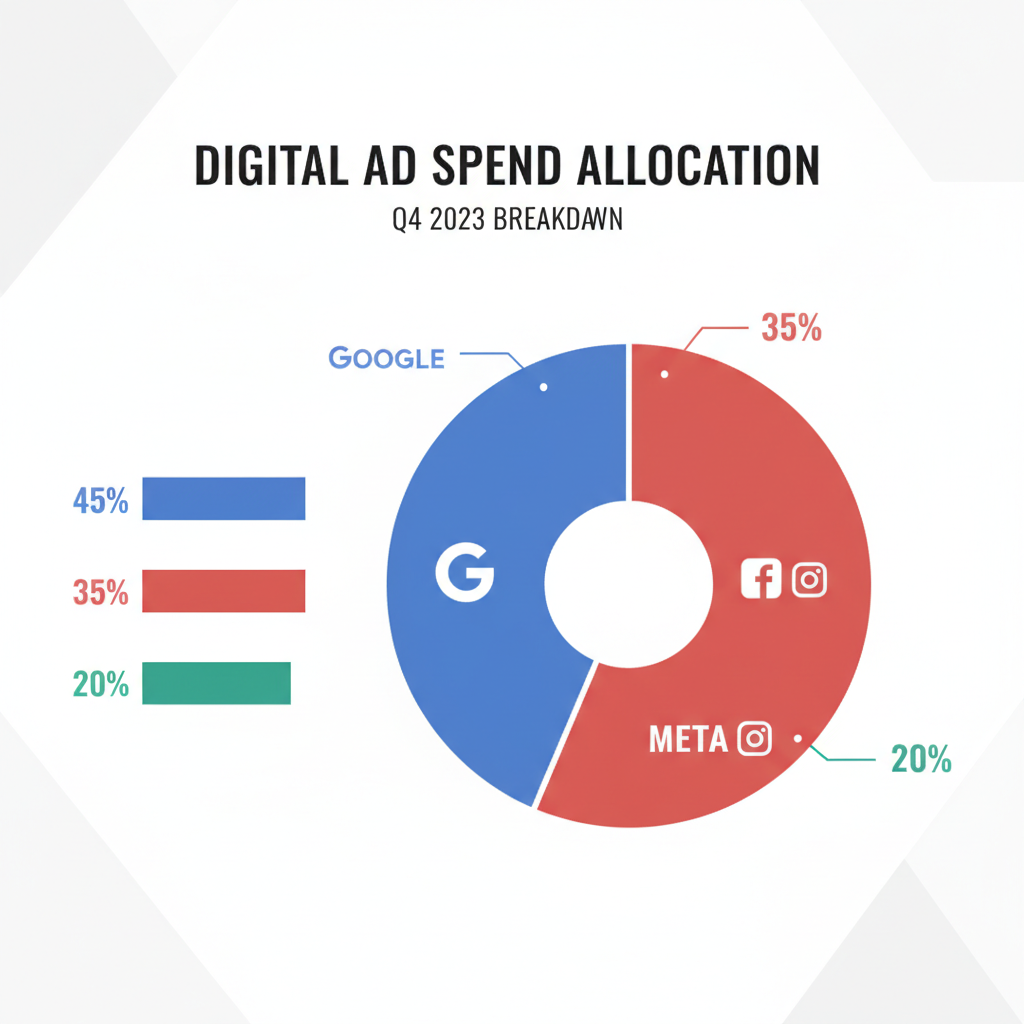
The single most common question from growing advertisers: "How should I split my budget across platforms?" It's also one of the most consequential decisions you'll make. Put too much into one platform and you miss opportunities elsewhere. Spread too thin and you never achieve the critical mass needed for algorithms to optimize effectively.
Most marketers approach budget allocation haphazardly—starting with one platform, adding another when they feel ready, then wondering why performance becomes inconsistent as budgets fragment. Without a strategic framework, you're essentially guessing how to distribute the resource that determines your entire advertising operation.
The reality is that multi-platform advertising isn't about choosing Meta versus Google versus TikTok. It's about orchestrating them strategically to maximize your total return. Each platform serves different purposes, reaches different audiences at different stages, and requires different budget levels to work effectively.
This comprehensive guide provides a proven framework for allocating advertising budget across Meta, Google, TikTok, and other platforms. You'll learn the 70-20-10 allocation rule, how to assess which platforms deserve your investment, budget distribution by business type, when to reallocate between platforms, and how to test new channels without derailing working campaigns.
Why Platform Diversification Matters
Relying on a single advertising platform creates concentrated risk and limits growth potential. Understanding why diversification matters drives better allocation decisions.
Algorithm Dependency RiskEvery platform's algorithm changes regularly. Meta's iOS 14.5 privacy updates devastated thousands of advertisers who depended exclusively on Facebook. Google's automation shifts have changed optimal account structures three times in five years. TikTok's algorithm changes can drop account performance by 30% overnight.
When you concentrate 100% of budget on one platform, any algorithm change, policy update, or platform issue can eliminate your entire customer acquisition channel instantly. Diversification across multiple platforms insulates you from single-platform volatility.
Audience Coverage GapsDifferent platforms reach different audiences:
- Meta (Facebook/Instagram): 2.9 billion monthly users, strongest with ages 25-54, broad demographic coverage
- Google Search: 8.5 billion daily searches, high-intent users actively seeking solutions
- TikTok: 1.1 billion monthly users, strongest with ages 18-34, entertainment and discovery mindset
- LinkedIn: 900 million users, B2B professionals and enterprise decision-makers
- Pinterest: 450 million users, strong with women ages 25-44, high purchase intent for lifestyle categories
Using only Meta means you miss the 40% of your target audience who primarily use other platforms. Using only Google Search means you never reach users who don't yet know they need your solution.
Intent Level AlignmentEach platform captures users at different stages of the customer journey:
High Intent (Ready to Buy):- Google Search Ads
- Google Shopping
- Amazon Advertising
- YouTube Ads
- Meta (Facebook/Instagram) conversion campaigns
- LinkedIn Sponsored Content
- TikTok Ads
- Meta Awareness campaigns
- Pinterest Ads
- Snapchat Ads
A complete funnel strategy requires budget allocation across all intent levels. Top-of-funnel platforms fill your remarketing audiences, mid-funnel platforms nurture consideration, and bottom-funnel platforms capture conversions.
Cost Efficiency Through ArbitrageDifferent platforms have different costs for similar audiences:
- Meta CPM: $8-$15 for most audiences
- Google Display CPM: $3-$8
- TikTok CPM: $6-$12
- LinkedIn CPM: $30-$50
- YouTube CPM: $10-$20
By diversifying across platforms, you can reach similar users at different costs, lowering your blended customer acquisition cost. Often the most cost-efficient approach is using cheaper awareness platforms (Google Display, Meta awareness) to build audiences, then retargeting them on higher-converting platforms.
Platform Strength AlignmentEach platform has core strengths:
- Meta: Dynamic product ads, broad targeting with AI optimization, visual storytelling
- Google Search: Intent capture, direct response for known needs
- Google Shopping: E-commerce product discovery and comparison
- YouTube: Long-form storytelling, demonstration, education
- TikTok: Trend-driven viral content, young audience engagement
- LinkedIn: B2B lead generation, professional audiences
- Pinterest: Visual discovery for home, fashion, food, DIY
Matching your products and goals to platform strengths improves efficiency. Home decor brands perform exceptionally on Pinterest. Complex B2B software needs LinkedIn's professional context. Trendy consumer products thrive on TikTok.
Learning and Testing VelocityRunning campaigns across multiple platforms accelerates learning. You discover which creative approaches, offers, and audiences work best faster when testing across different environments. A creative that underperforms on Meta might excel on TikTok, revealing insights about message-market fit.
Platform diversification isn't about spreading thin—it's about building resilience, expanding reach, matching intent levels, optimizing costs, and accelerating learning. The question isn't whether to diversify, but how to allocate budget strategically across platforms.
The 70-20-10 Budget Allocation Rule
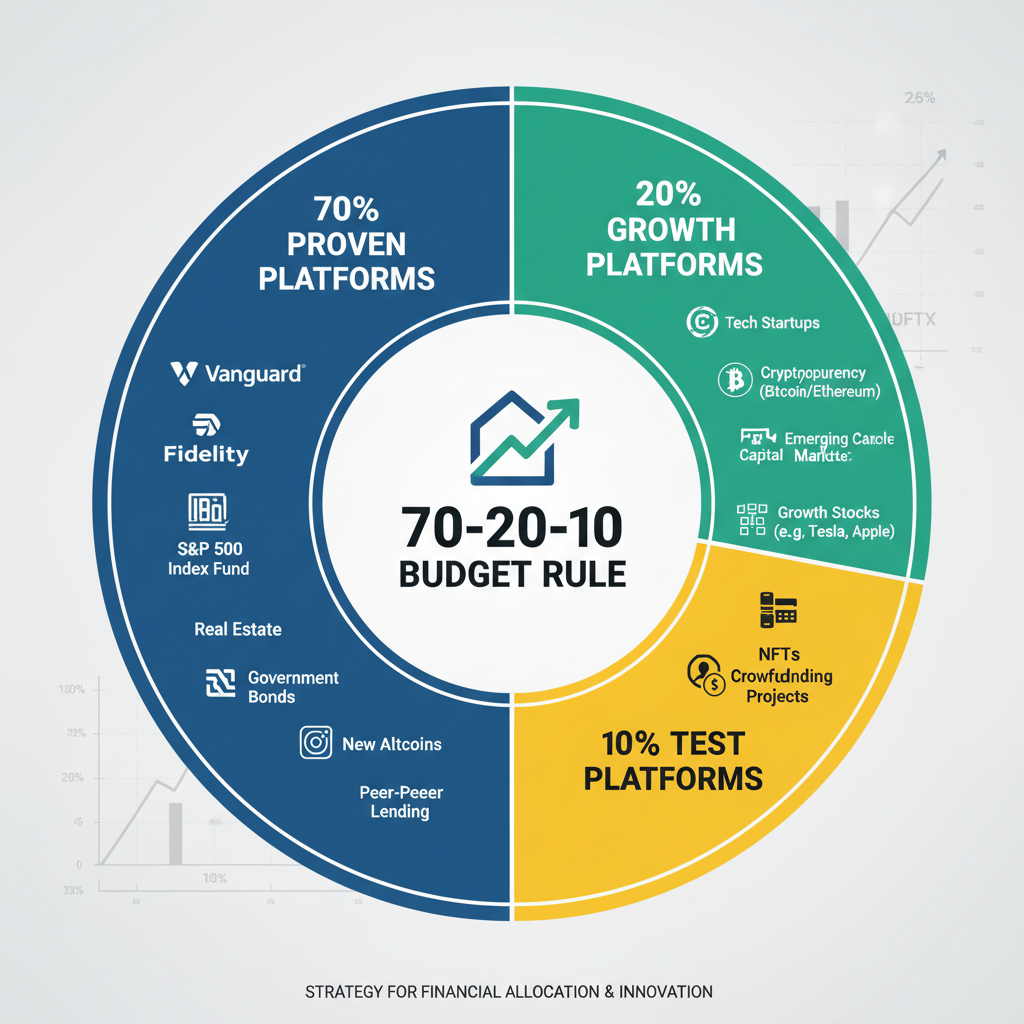
The 70-20-10 framework provides a starting point for strategic budget distribution across proven platforms, growth opportunities, and experimental channels.
70% - Proven Platforms (Core Performance)Allocate 70% of your total advertising budget to platforms and campaigns that consistently deliver your target ROAS or CPA. These are your established, predictable performers.
Characteristics of 70% Platforms:- Proven ROAS above your breakeven for at least 3 months
- Sufficient data (500+ conversions monthly minimum)
- Stable performance month-over-month (variance <20%)
- Clear optimization playbook you've developed
- Room to scale (not audience-saturated)
- Meta (Facebook/Instagram) conversion campaigns: 45%
- Google Shopping: 25%
- Total: 70% of budget
This core allocation provides predictable revenue and baseline performance. Don't starve your winners to chase new opportunities.
20% - Growth Platforms (Expansion Opportunities)Allocate 20% of budget to platforms showing promise but not yet fully proven. These are channels you're actively scaling and optimizing.
Characteristics of 20% Platforms:- Showing positive ROAS but inconsistent or below target
- Still learning optimal targeting, creative, and strategy
- Limited data (100-500 conversions monthly)
- Room for significant improvement through optimization
- Clear pathway to becoming a 70% platform
- Google Search (brand + non-brand): 12%
- YouTube (prospecting): 8%
- Total: 20% of budget
The 20% allocation allows meaningful testing without risking your core performance. Budget is sufficient for platforms to optimize but not so large that poor performance significantly hurts overall results.
10% - Test Platforms (Experimental Channels)Allocate 10% of budget to experimental platforms, new campaign types, or innovative approaches. This is your innovation budget for discovering tomorrow's winners.
Characteristics of 10% Platforms:- Unproven or early-stage testing
- Insufficient data for confident conclusions
- High risk, high potential reward
- Testing new platforms, new campaign types, or new targeting approaches
- TikTok (initial testing): 6%
- Pinterest (pilot): 4%
- Total: 10% of budget
The 10% allocation limits downside risk while providing enough budget to get meaningful test results. Most experimental platforms will fail to become core performers, but the successful ones justify the testing investment.
Applying the 70-20-10 RuleFor a $50,000 monthly advertising budget:
- $35,000 (70%) → Meta conversion campaigns ($22,500) + Google Shopping ($12,500)
- $10,000 (20%) → Google Search ($6,000) + YouTube ($4,000)
- $5,000 (10%) → TikTok testing ($3,000) + Pinterest testing ($2,000)
This distribution ensures:
- Majority of budget goes to proven performers
- Meaningful investment in growth channels
- Continuous testing of new opportunities
- Risk-appropriate allocation
The 70-20-10 percentages aren't fixed. They shift as platforms mature:
Month 1:- Meta: 70% (proven)
- Google Shopping: 20% (growth)
- TikTok: 10% (test)
- Meta: 50% (proven)
- Google Shopping: 20% (proven)
- TikTok: 20% (growth)
- YouTube: 10% (test)
- Meta: 40% (proven)
- Google Shopping: 20% (proven)
- TikTok: 10% (proven)
- Google Search: 20% (growth)
- LinkedIn: 10% (test)
Platforms graduate from 10% test to 20% growth to 70% proven as they demonstrate consistent performance. The framework is a decision-making tool, not a rigid constraint.
When to Deviate from 70-20-10 Aggressive Growth Mode:If you're well-funded and prioritizing growth over efficiency, shift to 50-30-20 to accelerate platform testing and expansion.
Conservative/Profitability Mode:If focusing on profitability over growth, shift to 80-15-5 to maximize allocation toward proven performers and minimize risk.
Platform Maturity:If you only have one proven platform, you might run 70-0-30 (70% proven, 30% split across multiple tests) until you develop a second proven channel.
Seasonal Adjustments:During peak seasons (Q4, major sales events), shift toward 80-15-5 to maximize performance from proven channels. During slower periods, shift to 60-25-15 to accelerate testing.
The 70-20-10 framework provides strategic structure while maintaining flexibility for your specific situation. Use our Budget Allocator to calculate exact dollar amounts for each category based on your total budget.
Assessing Platform Performance for Your Business
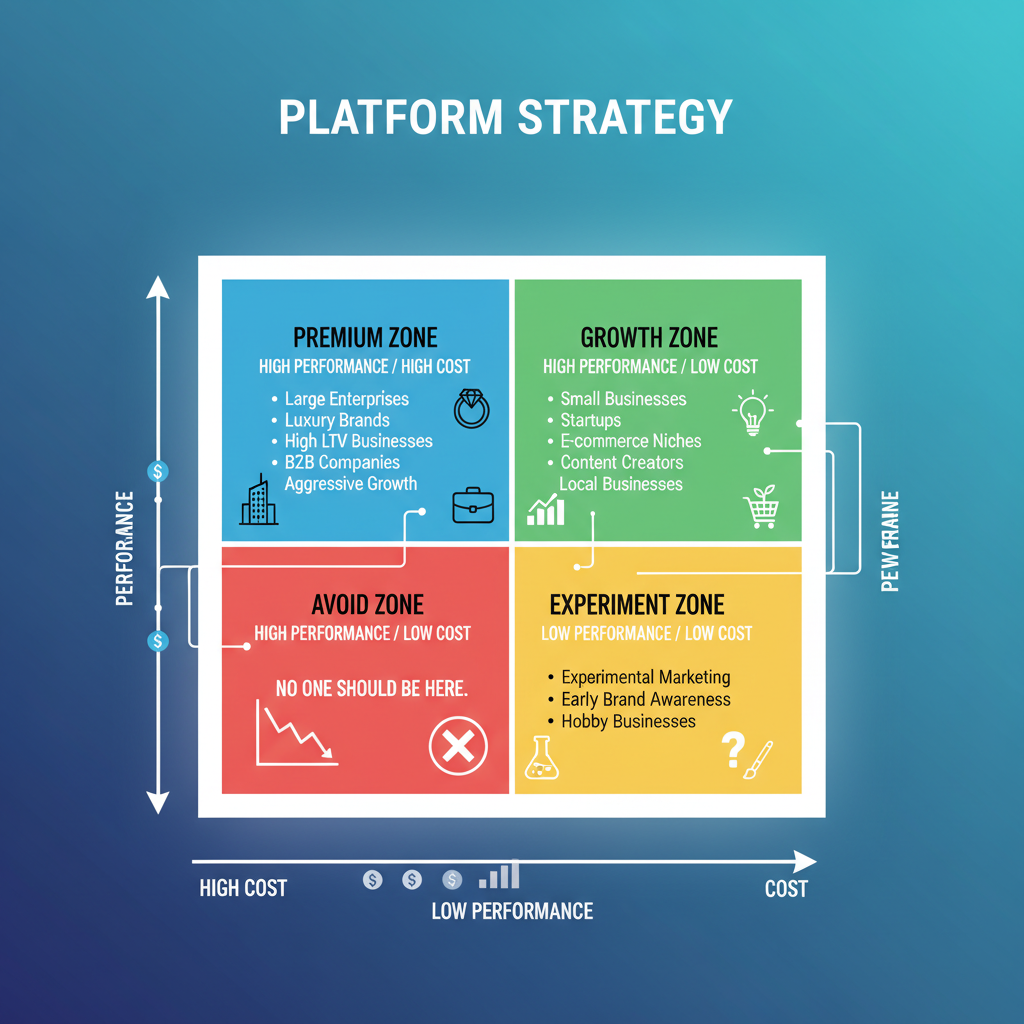
Not all platforms work equally well for all businesses. Strategic allocation requires assessing which platforms align with your specific business model, audience, and objectives.
Platform Assessment FrameworkEvaluate each platform across five dimensions:
1. Audience Match (0-10 Score)How well does the platform's user base match your target customer?
Questions to assess:- Does our target demographic actively use this platform?
- Is the platform mindset compatible with our product? (entertainment vs. problem-solving vs. research)
- Can we reach our target audience through available targeting options?
- What percentage of our target market is reachable on this platform?
- 8-10: Excellent match, core audience heavily uses platform
- 5-7: Moderate match, some audience segments present
- 0-4: Poor match, limited target audience presence
Example: B2B enterprise software assessing TikTok:
- Target demographic (executives 40-60): Score 3
- Platform mindset (entertainment): Score 2
- Targeting capability: Score 4
- Average Audience Match: 3/10
How well does user intent on the platform match your sales cycle stage needs?
Questions to assess:- Are users seeking solutions (high intent) or being entertained (low intent)?
- Does our product require education before purchase?
- What typical consideration cycle does this platform support?
- Can the platform serve our funnel needs (awareness, consideration, or conversion)?
- 8-10: Perfect intent match for your product's consideration cycle
- 5-7: Can work with right approach but not natural fit
- 0-4: Intent mismatch creates uphill battle
Example: Impulse purchase product assessing Google Search:
- User intent level: Score 10 (high intent)
- Consideration cycle support: Score 6 (works but slower than discovery platforms)
- Funnel stage match: Score 8 (bottom funnel strong)
- Average Intent Alignment: 8/10
Can you consistently produce the creative formats this platform requires?
Questions to assess:- Do we have resources for required creative formats (video, images, copy)?
- Does this platform's creative style match our brand capabilities?
- Can we maintain creative refresh rates needed for performance?
- Do we have product content that works in this format?
- 8-10: Creative requirements match current capabilities perfectly
- 5-7: Manageable with some resource expansion
- 0-4: Significant creative capability gap
Example: Service business with limited visual assets assessing Instagram:
- Visual content availability: Score 4
- Video production capability: Score 3
- Creative refresh capacity: Score 5
- Average Creative Requirements: 4/10
What actual results have you achieved or observed in your industry?
Questions to assess:- Have you tested this platform previously? What were results?
- What performance do competitors achieve on this platform?
- What do industry benchmarks suggest for our category?
- Are there case studies of similar businesses succeeding here?
- 8-10: Proven strong performance in your account or category
- 5-7: Mixed results or limited data but promising signals
- 0-4: Poor historical performance or no category success stories
Can you allocate sufficient budget to test this platform effectively?
Questions to assess:- What minimum budget does this platform need for algorithm optimization?
- Can we afford 4-6 weeks of testing at minimum spend levels?
- Does our total budget support adding this platform?
- Will budget be sufficient for statistical significance?
- 8-10: Budget easily supports platform requirements
- 5-7: Budget sufficient but tight for testing
- 0-4: Budget insufficient for meaningful test
- Audience Match: 9
- Intent Alignment: 8
- Creative Requirements: 9
- Historical Performance: 9
- Budget Requirements: 9
- Total: 44/50 → Core 70% platform
- Audience Match: 8
- Intent Alignment: 7
- Creative Requirements: 6
- Historical Performance: 5
- Budget Requirements: 7
- Total: 33/50 → Test 10% platform with growth potential
- Audience Match: 3
- Intent Alignment: 4
- Creative Requirements: 7
- Historical Performance: 2
- Budget Requirements: 3
- Total: 19/50 → Avoid, poor fit
- 40-50 points: Core 70% allocation candidate—proven fit
- 30-39 points: Growth 20% allocation candidate—promising but needs development
- 20-29 points: Test 10% allocation candidate—experimental only
- Below 20: Avoid—poor strategic fit
Assess each platform systematically before allocating budget. Use our Daily Budget Calculator to determine if you can meet minimum budget requirements for each platform you're considering.
Budget Distribution by Business Type
Optimal budget allocation varies significantly based on business model. Here are framework recommendations by business type:
E-commerce: Physical Products Recommended Platform Mix: Primary Platforms (70%):- Meta (Facebook/Instagram): 40-50%
- Google Shopping: 20-30%
- Google Search (brand + high-intent keywords): 10-15%
- YouTube: 5-10%
- TikTok: 5-10% (younger demographics)
- Pinterest: 0-5% (relevant categories: home, fashion, food)
- Meta: $13,500 (45%)
- Google Shopping: $7,500 (25%)
- Google Search: $4,500 (15%)
- YouTube: $2,400 (8%)
- TikTok: $2,100 (7%)
- Meta (Facebook/Instagram): 50-60%
- Google Search: 10-20%
- YouTube: 10-15%
- Google Display: 5-10%
- TikTok: 5-10%
- Podcast Advertising: 0-5%
- Meta: $27,500 (55%)
- YouTube: $7,500 (15%)
- Google Search: $7,500 (15%)
- TikTok: $4,000 (8%)
- Google Display: $3,500 (7%)
- Google Search: 40-50%
- LinkedIn: 20-30%
- Google Display Retargeting: 10-15%
- YouTube: 5-10%
- Meta (Facebook): 5-10% (for specific targeting)
- Reddit: 0-5% (for technical products)
- Google Search: $18,000 (45%)
- LinkedIn: $10,000 (25%)
- Google Display: $5,200 (13%)
- YouTube: $3,600 (9%)
- Meta: $2,400 (6%)
- Reddit: $800 (2%)
- Meta (Facebook/Instagram): 40-50%
- Google Search: 20-30%
- YouTube: 10-15%
- TikTok: 5-10%
- App Install Campaigns: 5-10%
- Reddit: 0-5%
- Meta: $15,750 (45%)
- Google Search: $8,750 (25%)
- YouTube: $4,550 (13%)
- TikTok: $3,150 (9%)
- App Install: $2,100 (6%)
- Reddit: $700 (2%)
- Google Search (local): 50-60%
- Google Local Services Ads: 10-20%
- Meta (Facebook/Instagram): 15-20%
- YouTube: 0-5%
- Nextdoor: 5-10%
- Yelp Ads: 0-5%
- Google Search: $11,000 (55%)
- Meta: $3,600 (18%)
- Google Local Services: $3,000 (15%)
- Nextdoor: $1,600 (8%)
- Yelp: $800 (4%)
- LinkedIn: 40-50%
- Google Search: 20-30%
- YouTube: 10-15%
- Google Display Retargeting: 5-10%
- Industry Trade Publications: 5-10%
- Podcast Sponsorships: 0-5%
- LinkedIn: $27,000 (45%)
- Google Search: $15,000 (25%)
- YouTube: $7,200 (12%)
- Google Display: $4,800 (8%)
- Trade Publications: $4,200 (7%)
- Podcasts: $1,800 (3%)
- Meta (Facebook/Instagram): 35-45%
- Google Search: 25-35%
- Google App Campaigns: 10-15%
- TikTok: 5-10%
- Snapchat: 5-10%
- Twitter/X: 0-5%
- Meta: $40,000 (40%)
- Google Search: $30,000 (30%)
- Google App Campaigns: $13,000 (13%)
- TikTok: $9,000 (9%)
- Snapchat: $6,000 (6%)
- Twitter: $2,000 (2%)
These frameworks provide starting points. Adjust based on your specific audience, competitive dynamics, and performance data. Test the recommended mix for 60-90 days, then reallocate based on actual results.
When to Reallocate Budget Between Platforms
Static budget allocation leads to missed opportunities and persistent inefficiencies. Dynamic reallocation based on performance keeps your budget optimized.
Signals to Increase Platform Budget Signal 1: Consistent ROAS Above Target (+20% or more)When a platform consistently outperforms your target ROAS by 20% or more for 30+ days, it's signaling room to scale.
Action: Increase budget by 25-50% over 2-4 weeks while monitoring efficiency.Example: Target ROAS is 4x, Meta consistently delivers 5-6x for 6 weeks → Increase Meta budget from $15,000 to $20,000 monthly
Signal 2: Low Audience Saturation (<60% reach rate)If you're only reaching 50-60% of your available audience, there's room to expand budget without saturation.
Action: Increase budget to expand reach while maintaining frequency under 8.Example: Retargeting campaign reaches 12,000 of 25,000 available users (48% reach) → Increase budget to expand reach to 70-80%
Signal 3: Decreasing CPMs While Maintaining PerformanceFalling CPMs while ROAS remains stable indicates improving efficiency and auction competitiveness.
Action: Increase budget by 30-40% to capitalize on favorable auction dynamics.Example: CPM dropped from $12 to $8 over 4 weeks with stable ROAS → Increase budget to capture more inventory at favorable rates
Signal 4: Strong Performance with Budget LimitationsCampaigns hitting daily budget caps early in the day, leaving potential impressions unserved.
Action: Increase budget by 50-100% to capture full opportunity.Example: Campaign budget depletes by 2pm daily, leaving 10+ hours without coverage → Double budget to maintain coverage all day
Signals to Decrease Platform Budget Signal 1: Declining ROAS Below Threshold (>20% drop)When ROAS drops 20% or more below target and persists for 2+ weeks despite optimization efforts.
Action: Reduce budget by 30-50% while investigating root causes.Example: ROAS declined from 4.5x to 3.2x over 3 weeks after multiple optimization attempts → Reduce budget from $20,000 to $12,000
Signal 2: Frequency Above 10 with Performance DeclineHigh frequency (10+ impressions per user) combined with declining CTR or conversion rate indicates audience fatigue.
Action: Reduce budget by 25-40% or expand audience to reduce frequency.Example: Average frequency reached 12 with CTR dropping 35% over 4 weeks → Reduce budget by 30% or expand targeting
Signal 3: Rising CPAs Above ThresholdCost per acquisition increasing beyond profitable levels despite optimization.
Action: Reduce budget by 30-50% and reevaluate strategy.Example: CPA increased from $45 to $75 (target is $50) for 3 consecutive weeks → Reduce budget and test new approaches
Signal 4: Audience Saturation (>85% reach rate)Reaching 85%+ of available audience with no room to expand targeting.
Action: Reduce budget by 20-30% to prevent overexposure, or shift to different campaign objective.Example: Reaching 21,500 of 25,000 available users (86% reach) → Reduce budget or shift from prospecting to retargeting
Signals to Reallocate Between Platforms Signal 1: Relative Performance ShiftOne platform's ROAS increases significantly while another's declines.
Action: Shift 15-25% of budget from declining platform to improving platform.Example:
- Meta ROAS: 5.2x → 6.8x (up 31%)
- Google Shopping ROAS: 4.8x → 3.6x (down 25%)
- Action: Shift $3,000 from Google Shopping to Meta
Platform shows historically strong seasonal performance approaching.
Action: Temporarily shift 10-20% budget toward seasonally strong platform.Example: Pinterest historically performs 40% better during October-December for home decor → Shift budget from Meta to Pinterest for Q4
Signal 3: New Feature or Inventory AccessPlatform releases new ad format or targeting option that creates opportunity.
Action: Shift 10-15% test budget toward new opportunity.Example: YouTube launches new in-feed ads → Shift $2,000 from Google Display to YouTube for 30-day test
Reallocation Decision FrameworkUse this weekly assessment:
1. Review Performance: Check each platform's 7-day and 30-day ROAS, CPA, and efficiency trends
2. Identify Outliers: Flag platforms with >20% performance variance from target
3. Check Constraints: Review frequency, reach, and saturation metrics
4. Assess Opportunity: Determine if performance change is temporary or sustained
5. Execute Gradually: Make 25% budget changes maximum to avoid disruption
6. Monitor Impact: Track results for 7-14 days before additional changes
Reallocation Timing- Daily: Only for emergency issues (technical problems, policy violations)
- Weekly: Minor adjustments (<15% budget changes) based on performance trends
- Monthly: Significant reallocations (15-30% budget shifts) after consistent trend
- Quarterly: Strategic overhauls of allocation framework
Avoid knee-jerk reallocation based on single-day or even single-week performance. Wait for sustained trends (2-4 weeks minimum) before making significant changes.
Use our Budget Allocator and ROAS Calculator to model reallocation scenarios before implementing changes.
Testing New Platforms with Pilot Budgets
Adding new advertising platforms requires structured testing to determine viability without jeopardizing proven performance.
Pilot Budget Framework Determine Test Budget SizeNew platform testing requires sufficient budget for algorithm learning and statistical significance:
Minimum Test Budget Formula: For target CPA of $60:Minimum Monthly Budget = $60 × 50 = $3,000Minimum Monthly Budget = $60 × 50 = $3,000- Large budgets ($50k+ monthly): 5-8% to new platform tests
- Medium budgets ($20k-$50k monthly): 8-12% to tests
- Small budgets (<$20k monthly): 10-15% to tests (or delay testing until budget grows)
- Minimum: 4 weeks (50+ conversions)
- Standard: 6-8 weeks (100+ conversions)
- Extended: 12 weeks (for expensive products, long cycles)
- ROAS exceeds target by 20%+ (e.g., 4.8x when target is 4x)
- CPA below target by 15%+ (e.g., $42 when target is $50)
- Minimum 50 conversions in test period
- Action: Graduate to 20% growth platform allocation
- ROAS within 20% of target (e.g., 3.2-4.8x when target is 4x)
- CPA within 20% of target (e.g., $40-$60 when target is $50)
- Minimum 30 conversions in test period
- Clear path to optimization (identifiable issues to fix)
- Action: Continue testing with optimizations for another 4-8 weeks
- ROAS below 50% of target (e.g., <2x when target is 4x)
- CPA exceeds target by 40%+ (e.g., >$70 when target is $50)
- Unable to generate 20+ conversions in 8 weeks
- No clear optimization path
- Action: Pause or eliminate platform
- [ ] Install conversion tracking and test thoroughly
- [ ] Create 3-5 creative variations minimum
- [ ] Set up at least 2 targeting approaches to test
- [ ] Configure conversion events and attribution windows
- [ ] Launch with daily budget at 1/30th of monthly allocation
- [ ] Verify data accuracy in analytics platform
- [ ] Review daily spend pacing and adjust budgets
- [ ] Analyze early performance signals (CTR, engagement)
- [ ] Pause clear non-performers (campaigns with 0 conversions after 100+ clicks)
- [ ] Test 2-3 new creative variations
- [ ] Expand audience or narrow based on early signals
- [ ] Calculate ROAS and CPA at 4-6 week mark
- [ ] Analyze conversion quality (revenue per conversion, repeat rate)
- [ ] Compare platform performance to benchmarks
- [ ] Identify best-performing segments (audience, creative, placement)
- [ ] Make scale/continue/kill decision
- [ ] If scaling: Increase budget by 50% and expand winning segments
- [ ] If continuing: Implement major optimizations and test 4 more weeks
- [ ] If killing: Gradually decrease budget to $0 over 1 week
- Audience size and match to target customer
- Historical industry performance
- Creative requirements match
- Strategic importance
- 35-40 points: Priority 1 - Test immediately
- 25-34 points: Priority 2 - Test after Priority 1 proves in or out
- 15-24 points: Priority 3 - Test only if budget allows
- <15 points: Avoid - poor strategic fit
Budget Allocation Calculator and Template
Translate strategic frameworks into specific dollar amounts with this practical calculator approach. Budget Allocation TemplateStep Determine Total Monthly Budget
Start with your total available advertising budget: Total Monthly Budget: $___________ If you're unsure what to budget, use revenue-based method:Monthly Ad Budget = Monthly Revenue × Target Ad Spend Percentage- E-commerce: 8-15% of revenue
- SaaS: 20-40% of revenue (includes CAC for growth)
- Lead Gen: 10-20% of revenue
Step Allocate to 70-20-10 Categories
Proven Platforms (70%): $___________ × 0.70 = $___________Growth Platforms (20%): $___________ × 0.20 = $___________Test Platforms (10%): $___________ × 0.10 = $___________- Proven (70%): $21,000
- Growth (20%): $6,000
- Test (10%): $3,000
Step Assign Specific Platforms to Categories
Based on your platform assessment scores and business type recommendations: Proven Platforms ($21,000):Platform 1: ___________% = $___________Platform 2: ___________% = $___________Total: 100% = $21,000
Platform 3: ___________% = $___________Platform 4: ___________% = $___________Total: 100% = $6,000
Platform 5: ___________% = $___________Platform 6: ___________% = $___________Total: 100% = $3,000
Step Calculate Daily Budgets
Convert monthly allocations to daily budgets (monthly ÷ 30):Platform 1 Daily: $___________ ÷ 30 = $___________Platform 2 Daily: $___________ ÷ 30 = $___________Platform 3 Daily: $___________ ÷ 30 = $___________Use our Daily Budget Calculator to quickly convert monthly to daily budgets and account for different month lengths.
Step Validate Against Platform Minimums
Check each platform against minimum budget requirements:
Meta (Facebook/Instagram):- Minimum daily: $5 per ad set
- Recommended minimum for optimization: $20-50 per ad set
- Your daily budget: $___________
- Sufficient? Yes / No
- Minimum daily: $10 per campaign
- Recommended minimum: $30-100 per campaign
- Your daily budget: $___________
- Sufficient? Yes / No
- Minimum daily: $10 per campaign
- Recommended minimum: $50-150 per campaign
- Your daily budget: $___________
- Sufficient? Yes / No
- Minimum daily: $20 per campaign
- Recommended minimum: $50-100 per campaign
- Your daily budget: $___________
- Sufficient? Yes / No
- Minimum daily: $10 per campaign
- Recommended minimum: $100-300 per campaign (due to higher CPCs)
- Your daily budget: $___________
- Sufficient? Yes / No
If any platform allocation falls below minimum thresholds, either increase budget or remove that platform from your mix.
Complete Budget Allocation Example Business: E-commerce fashion brand Monthly Revenue: $200,000 Total Ad Budget: $30,000 (15% of revenue) Category Allocation:- Proven (70%): $21,000
- Growth (20%): $6,000
- Test (10%): $3,000
- Meta (45% of total): $13,500 ($450/day)
- Google Shopping (25% of total): $7,500 ($250/day)
- Google Search (13% of total): $3,900 ($130/day)
- YouTube (7% of total): $2,100 ($70/day)
- TikTok (7% of total): $2,100 ($70/day)
- Pinterest (3% of total): $900 ($30/day)
- All platforms meet minimum daily budgets ✓
- Meta has 3 ad sets at $150/day each ✓
- Total equals $30,000 ✓
Create simple tracking spreadsheet:
| Platform | Allocated Budget | Actual Spend | Revenue | ROAS | CPA | Status |
|----------|-----------------|--------------|---------|------|-----|--------|
| Meta | $13,500 | $_____ | $_____ | ___x | $__ | Proven |
| Google Shopping | $7,500 | $_____ | $_____ | ___x | $__ | Proven |
| Google Search | $3,900 | $_____ | $_____ | ___x | $__ | Growth |
| YouTube | $2,100 | $_____ | $_____ | ___x | $__ | Growth |
| TikTok | $2,100 | $_____ | $_____ | ___x | $__ | Test |
| Pinterest | $900 | $_____ | $_____ | ___x | $__ | Test |
| Total | $30,000 | $____ | $____ | ___x | $__ | |
Review monthly and reallocate based on performance.
Quarterly Reallocation ProcessEvery 90 days, reassess entire allocation:
- Calculate average ROAS by platform over full quarter
- Identify platforms exceeding targets (candidates for increased allocation)
- Identify underperformers (candidates for decreased allocation or elimination)
- Graduate test platforms to growth (if successful) or eliminate (if failed)
- Graduate growth platforms to proven (if consistent >3 months)
- Identify new platforms to test with freed budget
- Rebuild allocation for next quarter
This systematic approach ensures your budget allocation evolves with performance rather than remaining static.
Use our Budget Allocator to automatically calculate platform allocations and daily budgets based on your total budget and chosen percentages.
Conclusion: Creating Your Custom Allocation Strategy
Multi-platform budget allocation isn't about rigid formulas—it's about systematic decision-making that balances proven performance, growth opportunities, and experimental testing.
Your Budget Allocation Action Plan: This Week:- Assess your current budget distribution across platforms
- Calculate actual ROAS and CPA for each platform over last 30 days
- Categorize each current platform as Proven (70%), Growth (20%), or Test (10%)
- Identify misallocations (proven platforms under-funded, test platforms over-funded)
5. Use Budget Allocator to model optimal allocation
- Implement 70-20-10 framework with current platforms
- Complete platform assessment scoring (audience match, intent alignment, creative requirements)
- Identify 1-2 new platforms for testing next quarter
- Set up budget tracking template to monitor allocation vs. performance
- Establish reallocation triggers (ROAS thresholds, frequency limits, saturation metrics)
- Run complete pilot test of one new platform (6-8 weeks minimum)
- Graduate or eliminate test platforms based on performance
- Reallocate budget from underperformers to overperformers
- Refine allocation percentages based on your specific results
- Document learnings and update allocation framework
1. Start with proven performers: Don't starve your winners to chase new opportunities
2. Test systematically: One new platform at a time with adequate budget
3. Be patient: Allow 6-8 weeks minimum before judging new platforms
4. Reallocate dynamically: Review weekly, adjust monthly, overhaul quarterly
5. Match business model: Use business-type frameworks as starting points
6. Respect minimums: Don't spread too thin across platforms
7. Maintain discipline: Stick to 70-20-10 framework to balance risk and opportunity
The Allocation MindsetBudget allocation is a portfolio management exercise. Like financial investing, you need:
- Core holdings (70% proven platforms) for stability and predictable returns
- Growth positions (20% growth platforms) for expanding opportunities
- Speculative bets (10% test platforms) for discovering future winners
Don't expect every platform to work. Don't panic when new tests underperform initially. Don't rigidly stick with underperformers just because they worked historically.
Your budget allocation should be:
- Strategic (aligned with business goals and customer journey)
- Dynamic (evolving with performance data)
- Disciplined (following framework while allowing informed adjustments)
- Adequately funded (meeting platform minimums for real learning)
Multi-platform advertising is increasingly necessary for sustainable growth. Platform concentration creates risk. Platform diversification creates opportunity.
Start with the 70-20-10 framework, apply the business-type recommendations, test new platforms systematically, and reallocate based on performance. Within 6-12 months, you'll have developed a custom allocation strategy optimized for your specific business, audience, and market conditions.
The goal isn't to advertise on every platform—it's to find the optimal mix that maximizes your blended ROAS while minimizing platform risk. Sometimes that's 2 platforms. Sometimes it's 6. Let the data decide.
Calculate your optimal allocation using our Budget Allocator, track daily budgets with our Daily Budget Calculator, and measure performance across all platforms to build a resilient, high-performing advertising portfolio.
Budget allocation is the foundation of multi-platform success. Get it right, and you'll build a sustainable, scalable advertising operation. Get it wrong, and you'll chase trends while starving your winners.
Build your framework this week. Test it this month. Refine it this quarter. Scale it all year.