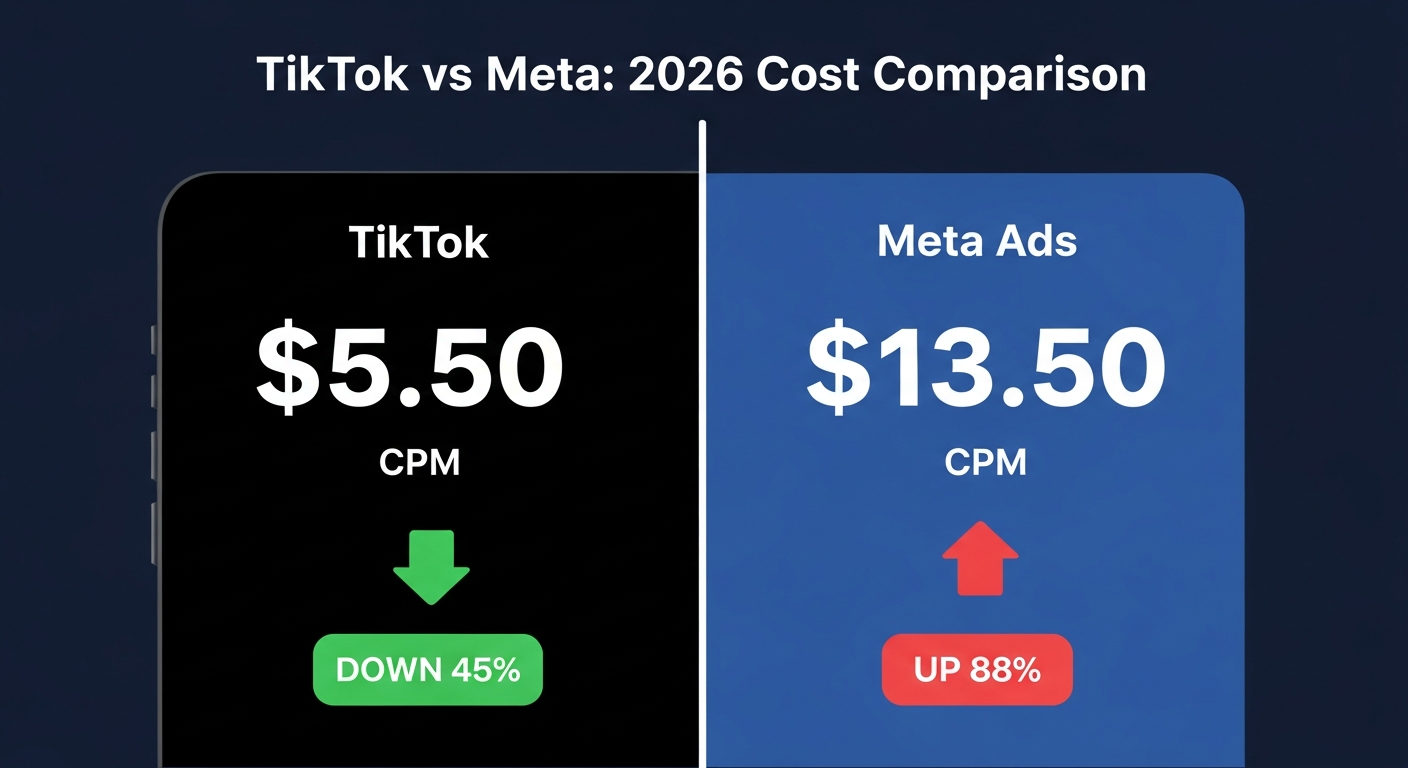
Historical analysis — Q1 2026 CPM data. See editor's note above for current figures.
The conventional wisdom used to be simple: TikTok is the expensive experimental channel, Meta is the workhorse where you know what you're paying. That's no longer true. As of early 2026, TikTok CPM has fallen to $5.50 while Meta CPM has climbed to $13.50. The two platforms have crossed, and if you're still allocating budget the old way, you're overpaying for awareness.
This piece breaks down the data behind that reversal, what drove it on each platform, and what it means for how you split budget today.
The Headline Finding: TikTok Is Now Cheaper Than Meta by CPM
Two independent data sources tell the same story. Gupta Media's tracker — aggregating billions of impressions — shows TikTok CPM dropping from $10.00 to $5.50, a 45% decline year-over-year. Superads, analyzing over $3 billion in Meta ad spend, shows Meta CPM moving the opposite direction: from $7.19 to $13.50, an 88% increase.
That's not a rounding error. Meta is now more than twice as expensive as TikTok on a cost-per-thousand-impressions basis.
| Platform | CPM | CPC | Best For | Pricing Trend |
|---|---|---|---|---|
| TikTok | $5.50 | N/A (CPM buying) | Awareness, Gen Z & Millennial reach, video-first brand building | ↓ Down 45% YoY |
| Meta | $13.50 | $1.10 (median) | Direct response, retargeting, conversion campaigns | ↑ Up 88% YoY |
| $33.80 | — | B2B, professional targeting, enterprise lead gen | Stable at premium | |
| Google Display | $3.00 | — | Retargeting, broad reach at scale, contextual | Stable / slight increase |
For context: LinkedIn at $33.80 CPM has always carried a B2B premium that most advertisers accept because of targeting precision. Google Display at $3.00 CPM sits at the bottom because it's largely contextual inventory without the behavioral targeting depth of social platforms. TikTok, at $5.50, now sits closer to Google Display than to Meta — that's a fundamental shift in the competitive pricing landscape.
Use the CPM Calculator to model what these rates mean for your specific impression targets and budget.
What Drove Meta CPM Up
Meta's CPM increase from $7.19 to $13.50 didn't happen in a vacuum. Several structural forces converged to push prices higher, and most of them are durable rather than temporary.
Advertiser Demand Kept Growing
Meta's advertiser base continues to expand. More small and mid-market businesses entered paid social between 2023 and 2025, many of them migrating from iOS-impacted organic channels. The auction dynamics are simple: more bidders competing for the same inventory means higher clearing prices. Meta's user growth in high-CPM markets (US, UK, Australia, Canada) has largely plateaued, so inventory didn't expand proportionally to demand.
iOS Privacy Changes Matured Into Structural Competition
Apple's App Tracking Transparency (ATT) framework, introduced in 2021, had a complex delayed effect on Meta CPMs. Initially it hurt Meta's performance (reducing targeting precision and thus willingness to pay), which pushed CPMs down in 2022-2023. But as advertisers adapted — building first-party data infrastructure, using Conversions API, shifting to broad targeting — their willingness to pay recovered and then increased. Advertisers who survived the ATT transition did so by proving Meta still worked for them. Those advertisers stayed in the auction with confidence, driving prices back up.
The advertisers who couldn't adapt dropped out, but they were replaced — and then some — by new entrants who entered a market where best practices for post-ATT measurement were already documented. The net effect: a more competitive, higher-CPM auction.
Q4 2025 Pricing Didn't Fully Revert
Q4 holiday seasons reliably spike CPMs 40-80% above Q3 levels. Historically, prices revert substantially in January. Q4 2025 pricing was exceptionally elevated, and the Q1 2026 reversion was shallower than in prior years. The baseline from which post-holiday prices fell was higher, and it settled at a higher floor. The $13.50 figure reflects early 2026 rates — meaning what would previously be a "discounted" post-holiday CPM is now higher than Meta's all-time peak CPM from just two years ago.
Meta's Ad Load Is Near Ceiling
There's a structural constraint on Meta's ability to add supply: ad load (the ratio of ads to organic content in a feed) has natural user experience limits. Meta has indicated it's operating near those limits in its core Feed and Stories placements. Reels inventory is expanding, but Reels CPMs are lower (less established conversion performance), so the high-value Feed inventory remains constrained even as Reels supply grows. Constrained supply plus growing demand equals higher prices.
What Drove TikTok CPM Down
TikTok's move from $10.00 to $5.50 CPM is driven by a different set of forces — some structural, some situational.
Platform Maturity Created More Ad Inventory
TikTok has scaled its advertiser-facing tools significantly over the past two years. More ad formats, improved targeting, better creative tools, and expanded placement options (including TikTok Search Ads) all mean more inventory available for auction. When supply grows faster than demand, prices fall. TikTok's ad inventory has expanded substantially while global demand hasn't kept pace — particularly in the US market, where uncertainty around the platform's regulatory status created a demand gap.
US Regulatory Uncertainty Suppressed Demand
The prolonged uncertainty around potential US legislative action against TikTok caused a meaningful pullback from US advertisers, particularly larger brands managing reputational risk. When major advertisers reduce spend or pause TikTok entirely as a precaution, auction prices drop. The advertisers who stayed — or shifted significant budget to TikTok — benefited from reduced competition in the auction. This dynamic has been visible in CPM data since mid-2024 and continued through early 2026.
This is partly a temporary condition. If regulatory clarity emerges, demand from cautious advertisers will return and CPMs will recover. The current $5.50 CPM may represent a window rather than a permanent floor.
Advertiser Sophistication Lagged Platform Capability
TikTok's lower-funnel conversion capabilities have improved considerably, but many advertisers still treat it as a pure awareness channel and cap their CPM bids accordingly. This collective undervaluation keeps auction prices lower than they would be if advertisers were fully utilizing TikTok's conversion optimization. As more brands prove out TikTok's DR performance and begin bidding on conversion outcomes rather than impressions, CPMs will rise. For now, the gap between platform capability and advertiser utilization depresses prices.
Geography and Audience Mix
TikTok over-indexes in younger demographics and in markets outside the US/UK premium tier. CPM averages reflect this audience mix — younger users and non-premium geographies carry lower CPMs. Meta's CPM average is pulled up by its broader demographic reach into older, higher-income cohorts that command premium pricing. When comparing platform-level averages, the audience composition difference explains part (though not all) of the gap.
What This Means for Budget Allocation
The practical implication is straightforward: if you're running both platforms for awareness or top-of-funnel reach, TikTok is now the efficient play by CPM, and Meta is the premium buy. That doesn't mean cut Meta — it means be intentional about why you're spending there.
Run the math on your own budget with the Budget Allocator. If you're spending $10,000/month on Meta awareness campaigns at $13.50 CPM, you're buying roughly 740,000 impressions. The same $10,000 on TikTok at $5.50 CPM buys 1.8 million impressions — 2.4x the reach for the same budget.
Implications by Campaign Objective
Brand awareness and reach campaigns: Shift toward TikTok. The CPM gap is too large to ignore for pure impression volume. If your goal is reaching as many relevant people as possible, TikTok's current pricing makes it the dominant option.
Video-first content: TikTok was already the natural home for this format, and the cost advantage makes the case stronger. Short-form video content designed for TikTok typically repurposes well to Reels, so the creative investment serves both platforms — but TikTok is where you're buying reach most efficiently.
Conversion campaigns: This is where the calculus changes. Meta's higher CPM buys access to mature conversion infrastructure, pixel data with years of optimization history, and audiences with demonstrated purchase behavior. Don't abandon Meta direct response based on CPM alone.
Retargeting: Meta remains the stronger retargeting platform for most advertisers. Custom audiences built on first-party data, advanced segmentation, and well-established conversion events give Meta a structural edge in lower-funnel work. The CPM premium is more justifiable here.
When Meta Still Wins Despite Higher CPM
CPM is a reach metric. What matters for most advertisers is cost per outcome — CPA, ROAS, cost per lead. Meta's higher CPM doesn't automatically mean worse economics if conversion rates offset the cost difference.
Conversion Rate Depth
Meta has over a decade of conversion optimization data, a mature pixel ecosystem, and audiences with documented purchase histories. For e-commerce, lead generation, and app install campaigns targeting 30-55 year old demographics, Meta's conversion rates routinely outperform TikTok by enough to justify the CPM premium. If Meta converts at 3x the rate of TikTok on a direct purchase campaign, paying 2.5x the CPM still yields better CPA on Meta.
Check your own CPA numbers across platforms before making reallocation decisions. Use the ROAS Calculator to model what each platform's conversion rate means for your return on spend.
Intent Matching in Mid-Lower Funnel
Meta's targeting infrastructure — particularly Custom Audiences and Lookalikes built on CRM data, website visitors, and purchase events — enables intent-matching that TikTok has not yet replicated at the same depth. When you're showing ads to people who viewed a product page three times without purchasing, Meta's audience tools are more precise. The cost of reaching a high-intent user on Meta is higher per impression but potentially lower per qualified click.
Older Demographic Reach
TikTok skews young. Effective reach against 45+ audiences on TikTok is limited — both because the user base is smaller and because older users may not be as receptive to TikTok's native ad formats. For brands selling to older demographics — financial services, home improvement, healthcare, certain travel categories — Meta's audience composition is irreplaceable at scale. No amount of CPM efficiency on TikTok makes up for the wrong audience.
Direct Response Maturity
Meta's Advantage+ Shopping Campaigns and broader automation suite have matured significantly. For e-commerce advertisers with healthy product catalogs and sufficient conversion data, these automated campaigns deliver consistent ROAS that TikTok's equivalent offerings haven't matched at scale. If you're generating 50+ purchases per week through Meta automation, the system is working — and switching budget to a less-proven automation system is a risk that the CPM difference may not justify.
When TikTok Wins on Cost Efficiency
TikTok's current pricing creates clear win conditions that didn't exist 18 months ago.
Top-of-Funnel Awareness at Scale
If your primary objective is brand awareness — building recognition and recall among a broad audience — TikTok's $5.50 CPM is the most efficient option in social advertising outside of Google Display. For brands that need to build mental availability quickly (new product launches, market entry, seasonal campaigns), buying 2.4x more impressions for the same budget is a meaningful advantage.
Younger Demographic Dominance
For Gen Z and younger Millennial audiences (18-34), TikTok offers both better reach and lower cost. If your customer base skews young, TikTok isn't just the cheaper option — it's the better targeting option. The CPM efficiency compounds with audience quality for brands in this demographic.
Video Creative Testing
Lower CPMs mean lower cost to reach a statistically significant audience for creative testing. If you need to test 10 creative variants to find the 2-3 that perform, doing that testing on TikTok at $5.50 CPM costs significantly less than running equivalent tests on Meta at $13.50. The savings can fund more tests or be reallocated to scaling what works.
Categories Where TikTok Intent Is Strong
TikTok has developed meaningful purchase intent in specific categories: beauty, fashion, food and beverage, fitness, and entertainment. The #TikTokMadeMeBuyIt dynamic is real and measurable. For brands in these verticals, TikTok's lower-funnel performance has improved enough that the CPM advantage translates into genuine ROAS efficiency — not just cheap impressions that don't convert.
Budget-Constrained Advertisers
For advertisers working with tight budgets — say, $3,000-$8,000/month — the CPM difference has outsized impact. At $5.50 vs. $13.50 CPM, a $5,000 awareness budget buys roughly 910,000 impressions on TikTok versus 370,000 on Meta. At limited scale, reaching more people matters more. Meta's conversion optimization advantages compound with data volume — at low spend, there often isn't enough data for Meta's systems to fully optimize anyway.
How to Use Both Together
The right answer for most advertisers running both platforms isn't to abandon one — it's to use each where it has structural advantages and stop using each where it doesn't.
A Funnel-Based Split
Treat TikTok as your top-of-funnel awareness engine and Meta as your mid-to-lower-funnel conversion engine. Use TikTok's lower CPM to build reach and introduce your brand to new audiences at scale. Then retarget those audiences — and lookalikes — on Meta, where conversion infrastructure is stronger. This approach leverages the pricing advantage of TikTok for impressions while leveraging Meta's conversion depth for outcomes.
The practical structure: 60-70% of prospecting/awareness budget to TikTok, 80-90% of retargeting and conversion budget to Meta. Adjust based on your actual platform-level ROAS data.
Creative Strategy Alignment
TikTok requires native-format creative — vertical video that looks organic, not repurposed display or TV creative. Meta accepts a wider range of formats but rewards video increasingly. If you're investing in TikTok, the creative needs to be purpose-built. A common mistake is running the same static image creative on both platforms, which underperforms on TikTok specifically. Budget for TikTok-native video production as part of the platform cost.
Attribution and Measurement
Meta and TikTok attribute conversions differently, with different default windows and different methodologies. Running both platforms simultaneously creates attribution overlap that inflates reported ROAS on both. Use your own analytics (Google Analytics 4, Shopify, or your preferred attribution tool) as the source of truth for cross-platform comparison. Don't compare Meta's self-reported ROAS to TikTok's self-reported ROAS — compare incremental revenue in your own data.
Set up platform-level holdout tests if budget allows — pausing one platform for a week and measuring downstream impact is the cleanest way to understand the true incremental contribution of each.
Watch for TikTok CPM Normalization
The current pricing gap reflects a specific market moment — regulatory uncertainty, faster inventory growth than demand growth, and advertiser hesitation. These conditions are not permanent. If regulatory clarity emerges and major brands return to TikTok, CPMs will rise. The current window of $5.50 CPM likely represents a cyclical low, not a new structural floor.
This means the opportunity to build TikTok audience reach cheaply is time-limited. Brands that establish TikTok presence now — while CPMs are suppressed — will have built audiences and accumulated conversion data before the platform becomes more expensive. The advertisers who wait until TikTok "proves itself" further will pay higher CPMs to enter a more competitive auction.
Budget Modeling Across Both Platforms
To model how the current CPM rates translate into your specific budget and impression targets, use the CPM Calculator to run platform-by-platform projections, and the Budget Allocator to stress-test different split scenarios against your awareness and conversion goals. Input your own historical conversion rates by platform — the CPM comparison is the starting point, but your actual cost-per-outcome data should drive the final allocation.
The headline is clean: TikTok is now cheaper than Meta on CPM by a factor of 2.5x. The analysis is more nuanced — CPM efficiency doesn't automatically translate to CPA efficiency, and Meta retains real structural advantages in direct response and conversion optimization. But the era of treating Meta as the low-cost option and TikTok as the premium experiment is over. The platforms have swapped positions, and your budget allocation should reflect that.