Lead Generation Campaign Blueprint: From Click to Qualified Lead
Your lead gen campaigns are generating clicks. Maybe even form fills. But your sales team keeps telling you the leads are garbage.
Sound familiar?
Here's the uncomfortable truth: 79% of marketing leads never convert to sales. Not because lead generation doesn't work. Because most advertisers optimize for the wrong thing. They celebrate a $15 cost per lead while ignoring that only 3% of those leads ever become customers.
This blueprint changes that. We're going to build a lead generation system that optimizes for qualified leads, not just form fills. From campaign architecture to lead scoring to budget allocation, every decision ties back to one metric: cost per qualified lead.
Why Most Lead Gen Campaigns Fail
The failure pattern is predictable. An advertiser launches a lead form campaign on Meta. The CPL looks amazing at $8. They scale the budget. Leads flood in. Sales calls them. Nobody picks up. The ones who do aren't decision-makers. The pipeline stays empty.
Three root causes kill lead gen campaigns:
1. Optimizing for volume instead of quality. When you tell Meta or Google to "maximize leads," the algorithm finds the cheapest leads possible. These are people who fill out forms casually, use fake emails, or have zero buying intent. The algorithm did exactly what you asked. You asked the wrong question.
2. No funnel alignment. Running a "book a demo" ad to someone who just learned your category exists is like proposing on a first date. The offer doesn't match the awareness stage. Industry data shows that B2B CPA averages $116.13 and Finance CPA runs $84.00. If you're seeing CPAs dramatically higher than these, misaligned funnels are likely the culprit.
3. No lead qualification layer. A name and email is not a lead. It's contact information. Without qualification questions, scoring, or progressive profiling, every form fill gets treated equally. Your sales team wastes hours chasing unqualified contacts while real prospects go cold.
Use our CPA Calculator to benchmark your current cost per lead against industry averages and identify where your funnel is leaking.
The Lead Generation Funnel Architecture
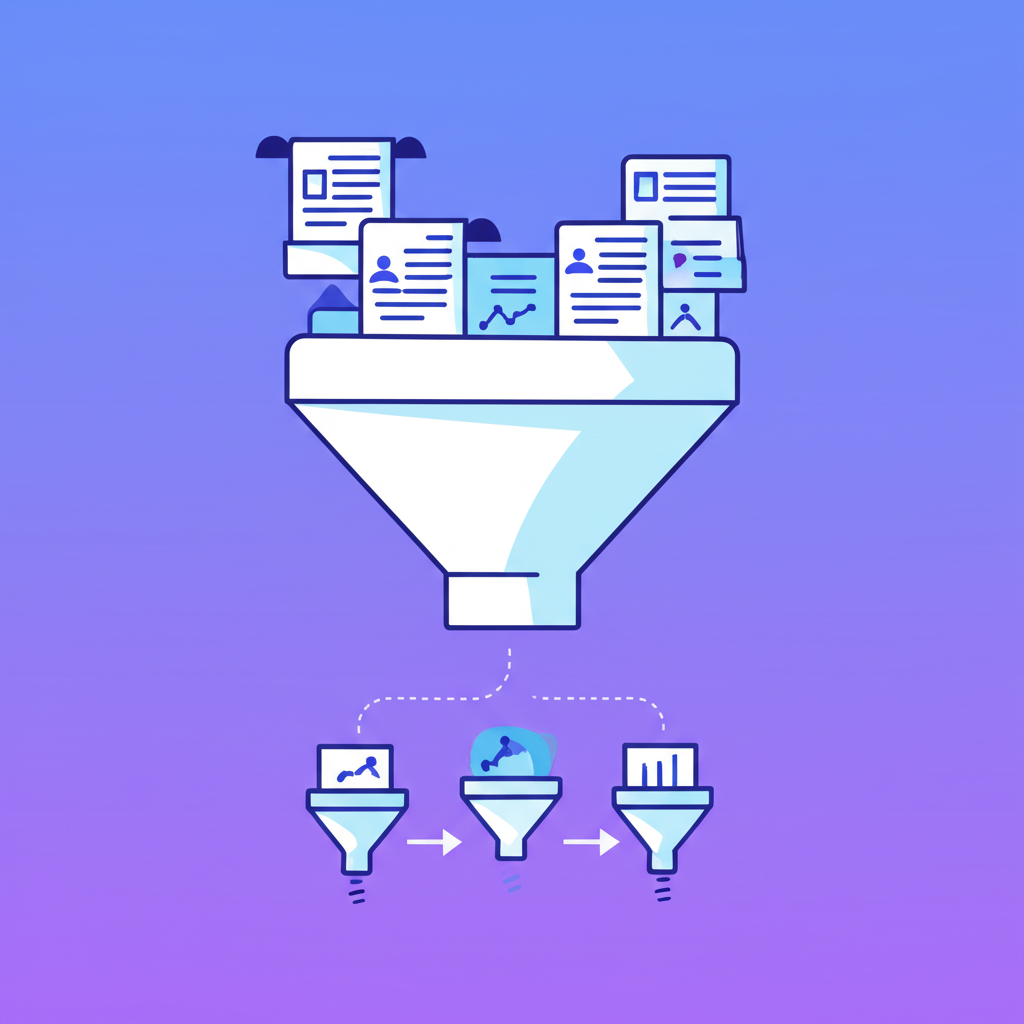
Effective lead gen isn't one campaign. It's a system with three distinct layers, each with its own objective, creative, and success metric.
Layer 1: Awareness and Education (Top of Funnel)
Objective: Get the right people to know you exist and engage with your content. You're not asking for anything yet. You're demonstrating expertise.
Content types that work: Industry reports, benchmark data, how-to guides, video explainers. On Meta, video content at this stage costs approximately $7.19 CPM. On LinkedIn, expect $33.80 CPM, but the audience quality for B2B is dramatically higher.
Success metric: Cost per engaged visitor (not just impressions). Track people who watch 75% of your video or spend 30+ seconds on your content.
Layer 2: Consideration and Capture (Middle of Funnel)
Objective: Convert engaged audiences into identifiable leads with a value exchange. Offer something genuinely useful in exchange for contact information.
Content types that work: Templates, calculators, detailed guides, webinar registrations, free assessments. The key is specificity. "Ultimate Marketing Guide" converts at 2%. "2024 B2B SaaS Benchmark Report" converts at 8%.
Success metric: Cost per lead (CPL) and lead-to-MQL conversion rate. If your CPL is low but MQL rate is under 10%, your offer is attracting the wrong people.
Layer 3: Decision and Qualification (Bottom of Funnel)
Objective: Move qualified leads toward a sales conversation. This is where demos, consultations, free trials, and assessments live.
Success metric: Cost per qualified lead (CPQL) and lead-to-opportunity rate. This is the number your sales team actually cares about.
Platform Selection for Lead Gen
Not every platform is built for lead generation. Here's where to invest based on your business model.
Google Ads: Highest Intent, Highest Competition
Google captures people actively searching for solutions. A prospect searching "best CRM for small business" is further down the funnel than someone scrolling Instagram. Average CPC runs $2.69, but conversion rates are 2-3x higher than social platforms for bottom-funnel queries.
Best for: B2B services, high-consideration purchases, local services. Run Search campaigns targeting problem-aware and solution-aware keywords. Layer remarketing via the Google Display Network at $2.80 CPM to stay visible during long decision cycles.
Meta (Facebook & Instagram): Volume and Lookalikes
Meta excels at middle-funnel lead capture. Native Lead Ads reduce friction by pre-filling forms. At $0.97 CPC, you can drive significant volume. The challenge is quality.
The fix: Use Instant Forms with "Higher Intent" settings. Add qualifying questions. Require manual entry instead of pre-fill for email. Yes, your CPL will increase. Your CPQL will decrease.
Best for: E-commerce lead gen, B2C services, webinar registrations, local businesses.
LinkedIn: Premium B2B Leads
LinkedIn is expensive. CPC averages $5.26 and CPM hits $33.80. But for B2B lead generation targeting decision-makers, nothing else comes close. You can target by job title, company size, industry, and seniority level.
LinkedIn Lead Gen Forms convert at 2-5x the rate of landing pages because the form auto-fills with verified professional data. A $40 CPL on LinkedIn often yields higher quality leads than a $12 CPL on Meta.
Best for: B2B SaaS, professional services, enterprise sales, recruiting.
Compare platform costs and performance side by side with our Platform Comparison Tool to find the right mix for your lead gen campaigns.
Campaign Structure by Funnel Stage
Here's the exact campaign structure that generates qualified leads systematically:
Top of Funnel Campaigns
- Campaign type: Video views, traffic, or engagement
- Targeting: Broad interest-based or lookalike audiences
- Budget allocation: 20-30% of total lead gen budget
- Creative: Educational content, industry insights, thought leadership
- KPI: Cost per ThruPlay (video) or cost per engaged session
Middle of Funnel Campaigns
- Campaign type: Lead generation or conversions
- Targeting: Retarget video viewers, website visitors, engaged users
- Budget allocation: 40-50% of total lead gen budget
- Creative: Lead magnets, webinar registrations, free resources
- KPI: Cost per lead and lead-to-MQL rate
Bottom of Funnel Campaigns
- Campaign type: Conversions optimized for high-value actions
- Targeting: Retarget lead magnet downloaders, pricing page visitors, repeat visitors
- Budget allocation: 20-30% of total lead gen budget
- Creative: Case studies, testimonials, demo offers, free trials
- KPI: Cost per qualified lead and cost per opportunity
Use our Budget Allocator to model different allocation scenarios across platforms and funnel stages.
Landing Page and Form Strategy
Your landing page is where leads are won or lost. The ad gets the click. The page gets the conversion.
The One-Page Rule: One offer. One CTA. No navigation menu. No footer links. Every element on the page either builds trust or drives the conversion. Everything else is a distraction.
Form length matters, but not the way you think. Conventional wisdom says shorter forms convert better. That's only half true. Shorter forms generate more leads. Longer forms generate better leads. A 3-field form (name, email, company) might convert at 20%. A 7-field form with qualifying questions might convert at 8%. But those 8% leads close at 4x the rate.
The sweet spot for B2B lead gen: 5-7 fields. Include at least one qualifying question like company size, budget range, or timeline.
Progressive profiling is the advanced move. Capture basic info on first touch. Ask additional questions on second and third interactions. By the time someone reaches your sales team, you have a complete profile without ever presenting a 15-field form.
Lead Scoring and Qualification
Not all leads deserve a sales call. Lead scoring separates the 20% worth pursuing from the 80% that waste your team's time.
Build a simple scoring model with two dimensions:
Demographic fit (who they are):
- Right job title: +20 points
- Right company size: +15 points
- Right industry: +10 points
- Has budget authority: +25 points
Behavioral engagement (what they've done):
- Downloaded lead magnet: +10 points
- Visited pricing page: +20 points
- Attended webinar: +15 points
- Visited 5+ pages: +10 points
- Returned within 7 days: +15 points
Score thresholds: 0-30 points = nurture with email. 31-60 = marketing qualified lead (MQL). 61+ = sales qualified lead (SQL), route to sales immediately.
This framework ensures your B2B CPA of $116.13 or Finance CPA of $84.00 is invested in leads that actually have a path to revenue.
Budget Allocation for Lead Gen Campaigns
Lead generation budgets fail when they're allocated by platform instead of by funnel stage. Here's a better framework:
The 30/50/20 Model for Established Businesses:
- 30% top of funnel: Build audiences and drive awareness
- 50% middle of funnel: Capture and nurture leads
- 20% bottom of funnel: Convert qualified leads
The 50/30/20 Model for New Campaigns:
- 50% top of funnel: You need to build audiences before you can retarget
- 30% middle of funnel: Start capturing as audiences build
- 20% bottom of funnel: Convert the warmest prospects
Within each stage, allocate across platforms based on where your audience is most active. For B2B, that typically means 40% Google, 35% LinkedIn, 25% Meta. For B2C services, shift to 50% Meta, 35% Google, 15% TikTok.
Model your exact budget splits with the Budget Allocator. Input your total monthly spend and see how different allocation strategies impact projected leads and CPAs.
Tracking Leads Across Platforms
Multi-platform lead gen creates a tracking nightmare if you don't set it up correctly from day one.
UTM parameters are non-negotiable. Every ad, every platform, every campaign needs consistent UTM tags. Use our UTM Builder to create standardized parameters across all your lead gen campaigns.
Recommended UTM structure for lead gen:
- utm_source: Platform (google, meta, linkedin)
- utm_medium: Campaign type (cpc, paid-social, display)
- utm_campaign: Funnel stage and offer (tofu-benchmark-report, mofu-webinar-q1, bofu-demo-request)
- utm_content: Ad creative variant (video-a, carousel-b, static-c)
Offline conversion tracking closes the loop. Upload your CRM data back into Google and Meta to tell the algorithms which leads actually became customers. This transforms your optimization from "get me cheap form fills" to "get me leads that close." Most advertisers skip this step. It's the single highest-impact optimization you can make.
Schedule your campaigns strategically using our Campaign Scheduler to ensure consistent lead flow across your sales team's capacity.
Optimizing Cost Per Lead Across Channels
Once your system is running, optimization becomes a weekly discipline. Here's the framework:
Week 1-2: Data collection. Don't touch anything. Let the algorithms learn. Resist the urge to kill campaigns that look expensive. You need at least 50 conversions per ad set for statistically significant data.
Week 3-4: First optimization pass. Pause the bottom 20% of ad sets by CPQL (not CPL). Shift budget to the top performers. Test new creative against your winners.
Month 2: Scale winners. Increase budget on winning campaigns by 20% every 3-4 days. Going faster causes the algorithm to re-enter learning phase. Build lookalike audiences from your best leads (not all leads, your best ones).
Ongoing: The quality feedback loop. Every two weeks, pull your CRM data. Which leads from which campaigns actually progressed through the pipeline? Feed this data back into your optimization decisions. A campaign with $50 CPL that converts 30% of leads to customers is infinitely better than a $15 CPL campaign that converts 2%.
Check your lead gen benchmarks against industry standards using our Advertising Benchmarks tool. Compare Google vs. Meta vs. LinkedIn performance data to identify where you're underperforming.
The bottom line: lead generation isn't about getting more names into a spreadsheet. It's about building a predictable system that delivers qualified prospects to your sales team at a sustainable cost. Start with the funnel architecture, align your campaigns to each stage, and optimize relentlessly for quality over volume.
Model your target CPAs with our CPA Calculator, then build the campaign structure to hit those numbers.
Related Guides: Budget Funnel Optimization Guide, Audience Targeting Guide, Cross-Platform Tracking Guide, Landing Page Optimization.