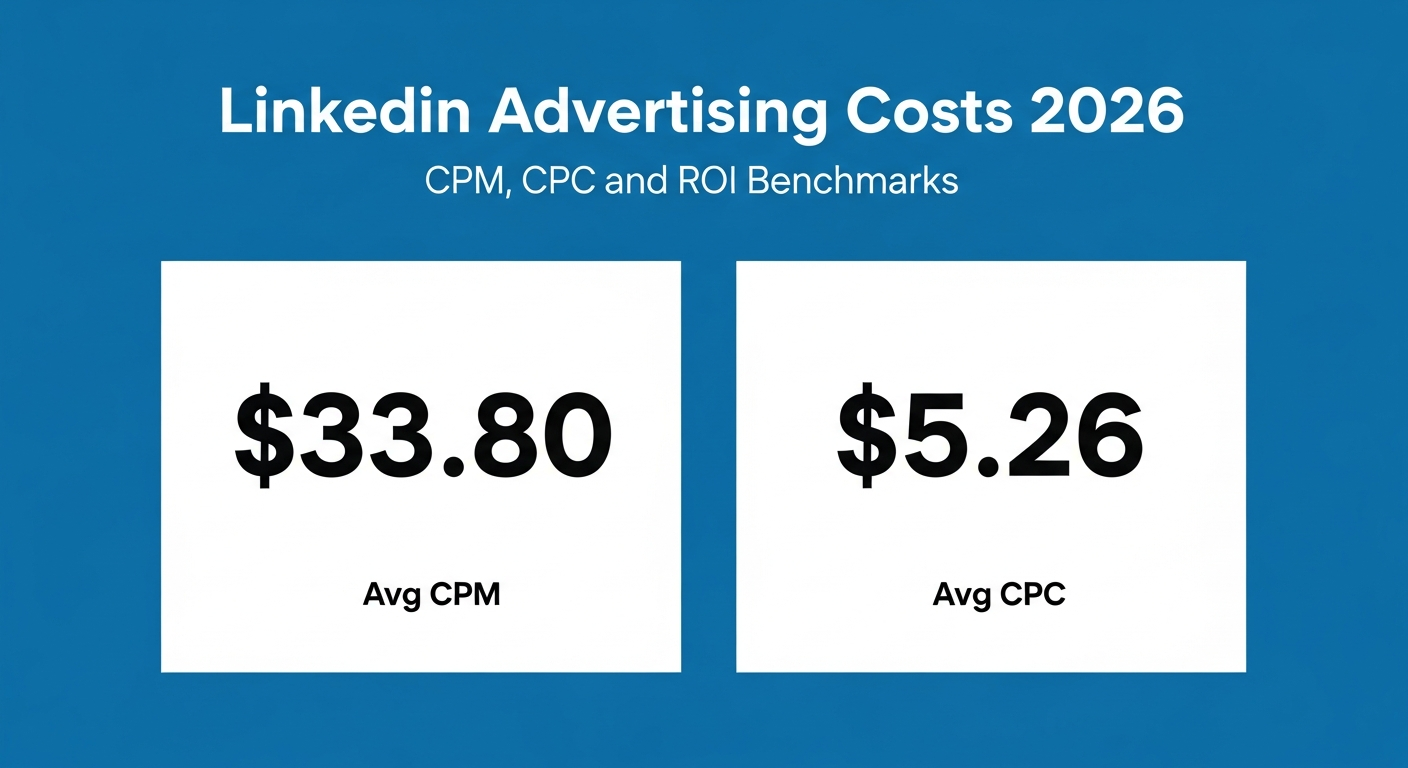
LinkedIn is the most expensive major ad platform. That statement is simply true, and any guide that dances around it is wasting your time.
A $36.00 CPM is 4.6 times what you'd pay on Meta ($7.80) and 4 times what you'd pay on TikTok ($9.00). A $6.50 average CPC sounds manageable until you realise that same click might cost $7–$9 for US-targeted campaigns aimed at senior decision-makers.
And yet, LinkedIn generates more B2B pipeline than any other paid social channel for most enterprise and mid-market businesses. The companies abandoning LinkedIn because of CPM sticker shock are often the same ones celebrating record quarters on the platform six months later — once they understand the right way to measure it.
This guide gives you the 2026 benchmark numbers, an honest framework for evaluating the cost-to-value relationship, and the specific tactics that reduce your costs without watering down the audience quality that makes LinkedIn worth anything in the first place.
Why LinkedIn is expensive — and when it's worth it
LinkedIn's costs are not a mistake or a platform inefficiency. They are a direct consequence of the data LinkedIn holds and the willingness of B2B advertisers to pay for it.
No other platform lets you target by job title, seniority level, company size, industry, years of experience, and specific skills simultaneously — with first-party data that members self-reported and actively maintain because their careers depend on accuracy. When you target "VP of Engineering at SaaS companies with 200–1,000 employees," you are reaching exactly that person. On Meta or Google, you are guessing.
That precision creates auction pressure. Every B2B software company, professional services firm, recruitment business, and financial institution is competing for the same audience segments. The CPM is high because the audience is genuinely valuable and the competition to reach it is intense.
The deal size threshold that changes everything
LinkedIn advertising makes financial sense when your average contract value (ACV) or customer lifetime value (CLV) is high enough to absorb the cost per acquisition. The general threshold most B2B advertisers work to: LinkedIn becomes cost-effective when ACV exceeds $10,000–$15,000.
Here's the logic. At a $6.50 CPC and a 2.23% conversion rate on your landing page, you're paying roughly $291 per lead. With a typical B2B sales qualification rate of 20–30%, you're looking at $970–$1,455 per sales-qualified lead. If your close rate is 25%, your cost per new customer approaches $3,880–$5,820.
For a $5,000 deal, those economics are borderline. For a $50,000 deal, they're exceptional. For a $250,000 enterprise contract, LinkedIn might be the cheapest customer acquisition channel you have.
Before running LinkedIn ads, calculate your allowable CPA. Use our CPA Calculator to work backwards from deal size and close rates — if the math doesn't support LinkedIn's costs, no amount of optimisation will fix that.
When LinkedIn is the wrong choice
LinkedIn advertising is a poor fit for: consumer products, low-margin businesses, deals under $5,000 ACV, companies relying on volume (many small purchases), and any campaign where job title or seniority targeting doesn't meaningfully improve lead quality. If you'd get equally good leads from Facebook's business owner audiences or Google's keyword intent targeting, the CPM premium on LinkedIn isn't justified.
2026 LinkedIn CPM and CPC benchmarks
These figures reflect Q2 2026 campaign data across industries and geographies. Use them as reference points, not targets — your numbers will vary based on audience, objective, and creative.
| Metric | LinkedIn (2026) | Confirmed Range | Notes |
|---|---|---|---|
| CPM | $36.00 | $33–$40 | Higher for senior/exec audiences |
| CPC | $6.50 | $5.50–$9.00 | US campaigns often $7–$9 |
| CTR (Sponsored Content) | 0.4–0.6% | 0.3–0.8% | Above 0.6% is strong performance |
| Conversion rate (landing page) | 2.23% | 1.5–4.0% | Lead gen forms convert significantly higher |
| B2B CPA | $116.13 | $75–$200+ | Varies heavily by offer type and vertical |
LinkedIn Lead Gen Forms (native forms that pre-populate member data) consistently outperform landing page conversion rates. Expect 8–13% conversion rates on well-structured lead gen form campaigns, which dramatically changes the CPA math. If you're sending all LinkedIn traffic to an external landing page, you're likely paying 3–5x more per lead than you need to.
How 2026 LinkedIn costs compare to other platforms
| Platform | Avg CPM (2026) | Avg CPC | Primary targeting signal |
|---|---|---|---|
| $36.00 | $6.50 | Professional profile (job title, company, seniority) | |
| Meta (Facebook/Instagram) | $7.80 | $1.10 | Behavioural interest, lookalike audiences |
| Google Search | N/A | $5.42 | Search intent (keywords) |
| TikTok | $9.00 | $1.00–$2.00 | Behavioural interest, engagement signals |
LinkedIn's CPC ($6.50) now exceeds Google Search ($5.42), but the platforms serve different purposes. Google Search captures people actively looking for a solution right now. LinkedIn reaches the right person at any point in their buying cycle. Neither is universally better; they serve different funnel stages. Use our CPM Calculator to model the cost difference across platforms for your specific campaign goals.
Cost by ad format (Sponsored Content, Message Ads, Dynamic Ads, Text Ads)
LinkedIn's cost structure varies significantly by format. Understanding which format matches your objective prevents overspending on the wrong placement.
| Format | Avg CPM | Avg CPC | Best for | Min daily budget |
|---|---|---|---|---|
| Sponsored Content (Single Image) | $34–$40 | $6–$9 | Brand awareness, content distribution, lead gen | $10 |
| Sponsored Content (Video) | $32–$42 | $6.50–$10 | Awareness, product demos, thought leadership | $10 |
| Sponsored Content (Carousel) | $32–$38 | $6–$8 | Multi-feature showcases, case studies | $10 |
| Message Ads (InMail) | $32–$52 equiv. | Per-send model | Direct outreach, event invitations, high-value offers | $10 |
| Dynamic Ads | $42–$58 | $9–$13 | Follower growth, personalised job ads | $10 |
| Text Ads | $15–$25 | $2–$5 | Budget-conscious campaigns, retargeting | $10 |
Message Ads (LinkedIn InMail): the highest-CTR format
Message Ads are charged per send rather than per impression, typically $0.50–$1.00 per message delivered. The CTR is dramatically higher than any display format — 2–5% average CTR compared to 0.4–0.6% for Sponsored Content. This makes Message Ads the best format for high-intent bottom-of-funnel offers: demo requests, event registrations, exclusive content.
The constraints: LinkedIn caps how often a member can receive Message Ads (one per 30 days from the same advertiser), members can see they're receiving an ad, and the format requires genuine value in the message itself. Promotional copy that reads like a cold sales email performs poorly. Useful, specific, personalised messages perform very well.
Text Ads: LinkedIn's underused budget option
Text Ads appear in the right-column sidebar on desktop only. They're LinkedIn's cheapest format at $2.50–$6.00 CPC and can run with the same precise audience targeting as Sponsored Content. CTR is low (0.025–0.1%), but if your goal is retargeting warm audiences or driving conversions at a lower cost ceiling, Text Ads deserve testing alongside your primary Sponsored Content campaigns.
Dynamic Ads: personalisation at a premium
Dynamic Ads auto-populate with the viewer's name, profile photo, and company — creating a personalised impression without additional creative work. The CPM premium ($42–$58) reflects this personalisation, and the format works best for follower campaigns and job advertising. For standard lead generation, the cost premium over Sponsored Content rarely justifies itself.
Cost by audience: why targeting precision drives up price
Your audience definition is the single largest cost lever on LinkedIn. Understanding how different targeting choices affect price helps you make deliberate trade-offs rather than defaulting to the broadest or narrowest possible audience.
Seniority targeting adds a significant premium
Targeting C-suite and VP-level audiences on LinkedIn costs meaningfully more than targeting individual contributors. The auction pressure from enterprise software, consulting, and financial services advertisers targeting these segments is intense. Expect CPMs 30–50% above platform average when targeting Director level and above.
The question to ask: does your product actually require C-suite approval to close, or are you reflexively targeting senior people because it feels more prestigious? Many B2B deals are initiated and championed by individual contributors and managers before ever reaching the executive level. If your product has a technical evaluation stage, targeting the people doing that evaluation — not their bosses — often delivers better pipeline at lower cost.
Company size targeting and its cost implications
Targeting enterprise accounts (1,000+ employees) carries a higher CPM than SMB targeting (10–200 employees), because enterprise accounts represent larger deal values and more advertisers want access to them. If your product serves both markets, segment your campaigns by company size and track CPA separately — you'll often find that one segment dramatically outperforms the other on a cost-per-pipeline basis.
Audience size and delivery efficiency
LinkedIn recommends minimum audience sizes of 50,000 members for Sponsored Content campaigns. Audiences below 10,000 members see significantly higher CPMs because the algorithm has fewer options to optimise delivery. If you're targeting a highly specific segment (e.g., "Head of Procurement at manufacturing companies with 500–5,000 employees in the UK"), you may need to broaden one dimension — add adjacent job titles, expand the company size range, or run in multiple geographic markets — to maintain delivery efficiency.
Layering vs. OR targeting
LinkedIn's campaign manager supports both AND (layered) and OR targeting logic. Layering multiple criteria narrows your audience (everyone must match all criteria) and increases CPM. OR targeting (e.g., "job title: Marketing Manager OR Marketing Director OR Head of Marketing") broadens reach. For most campaigns, OR targeting within a category — capturing all variants of a target job title — outperforms narrow AND targeting that shrinks the audience below the efficiency threshold.
LinkedIn vs other platforms: the true cost comparison
Comparing LinkedIn's $36.00 CPM to Meta's $7.80 or TikTok's $9.00 and concluding LinkedIn is "too expensive" misses the only comparison that matters: cost per qualified lead and cost per pipeline dollar generated.
A $6.50 CPC can be cheap or expensive — depending on what it produces
Consider two scenarios:
Scenario A: A TikTok campaign delivers a $1.20 CPC. 500 clicks generate 10 leads. None close. Cost per qualified lead: infinite. Total pipeline: $0.
Scenario B: A LinkedIn campaign delivers a $6.50 CPC. 500 clicks generate 30 leads via Lead Gen Form. 8 are sales-qualified. 2 close at $45,000 each. Pipeline: $90,000. Cost per closed deal: $1,625.
The LinkedIn campaign costs more per click and more per lead. It is dramatically cheaper at every stage that actually matters to the business.
This is not hypothetical — it is the pattern that emerges consistently when B2B companies do rigorous attribution across channels. The insight is directionally reliable enough that most B2B companies with ACV above $15,000 should have LinkedIn in their paid mix, even at these CPMs.
Platform fit by funnel stage
LinkedIn performs best at the top and middle of funnel: creating awareness among the right audience, capturing demand from people not yet in an active buying cycle, and nurturing leads over the long consideration periods typical in B2B.
Google Search and retargeting (on any platform) typically deliver better CPA at the bottom of funnel, where intent is established and you're converting known prospects. A well-structured B2B paid strategy uses LinkedIn to build the funnel and Google to capture the demand LinkedIn created — not as competing channels, but as complementary ones.
Model this with our Budget Allocator to see how splitting spend across LinkedIn and Google affects overall pipeline efficiency.
Calculating LinkedIn ROI: the right framework for B2B
The standard e-commerce ROAS formula — revenue divided by ad spend — doesn't work cleanly for B2B advertising with long sales cycles. A campaign that generates three enterprise opportunities in month one may not produce closed revenue for six to twelve months. Measuring ROAS on a monthly basis will make every LinkedIn campaign look like it's failing.
Use pipeline-based measurement instead
The framework most B2B teams find useful:
- Track cost per lead (CPL) — total spend divided by total leads generated
- Track cost per sales-qualified lead (SQL) — CPL divided by your lead-to-SQL rate
- Track cost per opportunity — cost per SQL divided by your SQL-to-opportunity rate
- Track pipeline generated — number of opportunities multiplied by average deal size
- Calculate pipeline ROI — pipeline generated divided by ad spend (a pipeline ROAS)
- Apply close rate to estimate revenue ROI — multiply pipeline ROAS by your historical close rate
A pipeline ROI of 5:1 (5x pipeline generated vs. spend) with a 25% close rate translates to 1.25:1 revenue ROAS — which sounds weak until you remember the sales cycle is 6–12 months and the numbers will mature over time. Use our ROAS Calculator to model what your break-even pipeline ROI needs to be given your close rate and ACV.
The B2B CPA benchmark: $116.13
The LinkedIn B2B CPA benchmark of $116.13 represents cost per lead across B2B industries. This number will look high or low depending entirely on your deal economics. For context:
- If your ACV is $5,000 and your close rate is 10%, you need a CPA below $500 to break even on advertising costs alone (before factoring in sales costs, customer success, etc.). $116 is well within that range.
- If your ACV is $100,000 and your close rate is 20%, an allowable CPA of $2,000+ is reasonable. $116 is extremely cheap.
- If your product costs $50/month and your average customer stays 18 months, your LTV is $900. A $116 CPA leaves thin margin before factoring in any other costs.
Use our CPA Calculator to find your specific allowable CPA before evaluating LinkedIn campaign performance against industry benchmarks.
Attribution challenges in long B2B cycles
LinkedIn campaigns often influence deals that close via other channels. A prospect sees three LinkedIn ads over two months, receives a targeted email, searches for your brand on Google, and converts through organic search. Last-click attribution credits Google. LinkedIn gets nothing in the report but generated the awareness that started the journey.
LinkedIn's own conversion tracking, CRM-based attribution, and UTM parameters all help, but no attribution model perfectly captures the full contribution. The practical solution: run LinkedIn for 90 days with proper tracking, pull a pipeline report, and compare the quality (deal size, close rate, sales cycle length) of LinkedIn-sourced leads versus other channel sources. Quality differences often justify cost differences that look bad in CPM comparisons.
How to reduce LinkedIn CPC without sacrificing audience quality
Reducing LinkedIn costs while maintaining the audience quality that makes the platform valuable requires more precision, not less. The tactics that genuinely work:
Bid on conversions, not impressions
LinkedIn's campaign objective selection directly determines your bid strategy options. Campaigns set to "Awareness" optimise for impressions at CPM rates. Campaigns set to "Lead Generation" or "Website Conversions" optimise for conversion events — and LinkedIn's algorithm learns to find the members in your audience most likely to convert.
Conversion-optimised campaigns typically deliver lower CPL than impression-optimised campaigns because you're buying outcomes, not eyeballs. The trade-off: conversion objectives need data to learn (LinkedIn recommends a minimum of 30+ conversions per month for the algorithm to function well), so new campaigns may start less efficiently and improve over time.
Narrow by company size, not just job title
Many advertisers define their audience by job title but leave company size broad. Adding company size targeting — particularly eliminating very small companies (1–10 employees) where your product isn't viable — reduces audience size but dramatically improves lead quality. Fewer leads at lower cost with higher close rates is almost always preferable to more leads at lower cost that waste sales team time.
Use Matched Audiences to prioritise warm prospects
LinkedIn's Matched Audiences feature lets you upload contact lists, target website visitors (retargeting), and build lookalike audiences from your best customers. Matched Audience campaigns consistently outperform cold prospecting on both CTR and conversion rate — which means lower effective CPC and lower CPA even if the nominal CPM is similar.
Practical implementation: upload your CRM contacts and create a "past leads not yet closed" audience. Target them with middle-funnel content (case studies, ROI calculators, comparison guides) at lower frequency than your cold prospecting campaigns. These warm audiences convert at 3–5x the rate of cold audiences.
Improve your offer before optimising bids
The fastest way to reduce cost per lead on LinkedIn is to improve what you're offering in exchange for the click and form submission. A white paper that's genuinely useful to your target audience will convert at 12–15% on a Lead Gen Form. A generic "schedule a demo" CTA from a brand prospects don't recognise might convert at 2–3%.
That difference means the white paper campaign generates 4–6x more leads at the same CPM and CPC. No bid optimisation comes close to the impact of the right offer to the right audience.
Test Message Ads for high-value segments
For your highest-priority audience segments — a specific list of target accounts, a narrow job title at mid-to-large companies — Message Ads' 2–5% CTR can produce CPLs that beat Sponsored Content despite a higher per-send cost. Run both formats in parallel against the same audience for 30 days and compare cost per SQL (not just cost per lead) before drawing conclusions.
Schedule ads during business hours
LinkedIn engagement peaks during weekday business hours (Tuesday through Thursday, 8am–5pm in your target audience's timezone). Pausing ads on weekends and evenings can reduce spend by 25–30% while losing only the least-engaged impressions. This isn't universally true — some audiences engage with LinkedIn content during commutes or evenings — but it's a reliable starting point for dayparting tests.
Monitor frequency carefully
LinkedIn recommends keeping ad frequency below 4 impressions per member per month to avoid creative fatigue. High frequency with the same creative drives CTR down and effective CPC up. Rotate creative every 4–6 weeks, test new messaging angles against your control, and retire underperforming variants quickly. Use our CPM Calculator to model how reach and frequency trade-offs affect your total cost structure.
The bottom line on LinkedIn advertising costs in 2026
LinkedIn's $36.00 CPM and $6.50 CPC are high by any cross-platform comparison. They are not high relative to what LinkedIn delivers for the right business: precise access to professional decision-makers that no other platform can match, with first-party targeting data that stays accurate because members maintain it themselves.
The businesses that get the most from LinkedIn treat the high CPM as a feature, not a bug. The expense signals that you're reaching a genuinely valuable audience. The question is never "how do we make LinkedIn cheaper?" — it's "does our deal economics justify what LinkedIn costs, and are we measuring its contribution correctly?"
If the answer to both is yes, LinkedIn at $36.00 CPM is one of the most cost-effective B2B acquisition channels available. If the answer to either is no, no amount of optimisation will change that — and redirecting budget to channels with better fit is the right call.
Run your numbers with the CPA Calculator, stress-test your pipeline assumptions with the ROAS Calculator, and model budget allocation between LinkedIn and other channels with the Budget Allocator before committing to LinkedIn at scale.