Minimum Ad Budget Guide: Platform Requirements for Meta, Google & TikTok
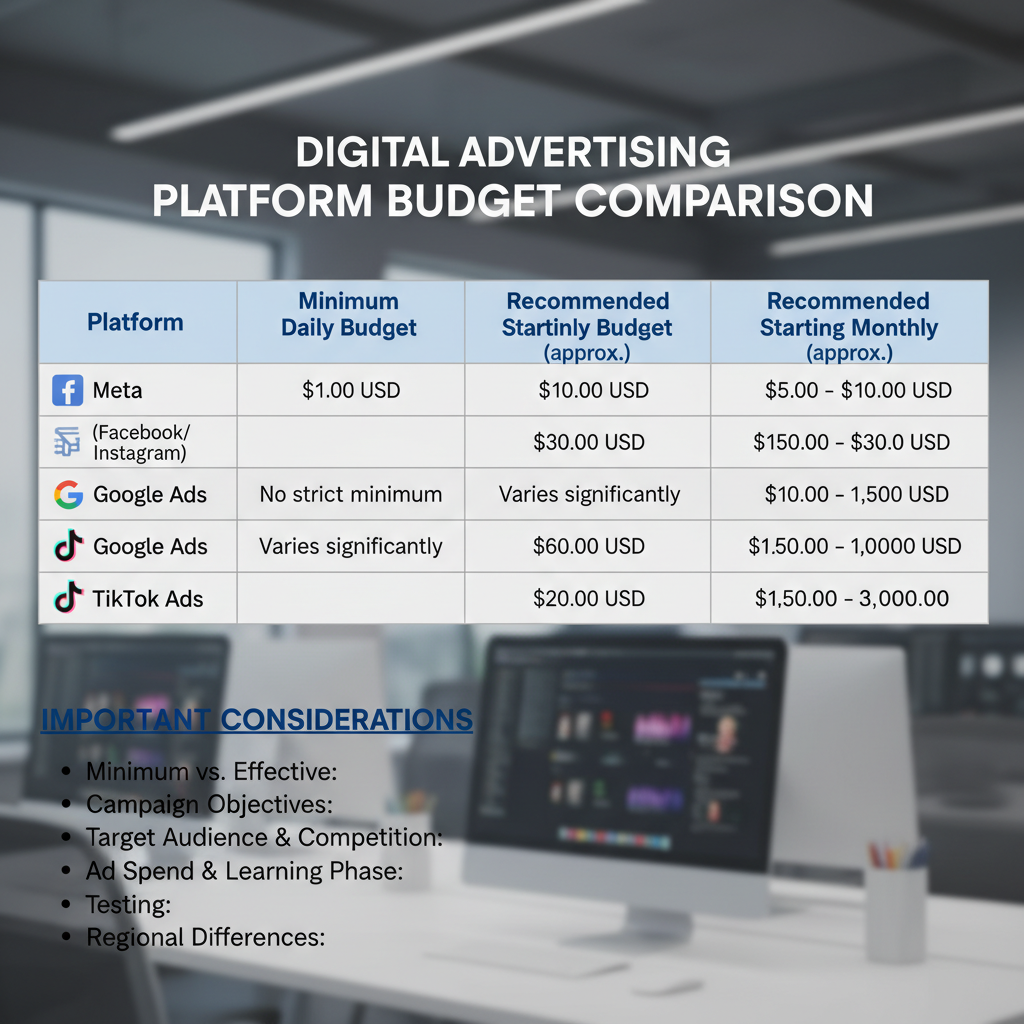
Starting paid advertising without understanding minimum budget requirements is like trying to start a fire with damp kindling—you'll burn through resources without generating the heat needed for sustained performance. Each advertising platform has functional minimums below which campaigns simply cannot gather enough data to optimize effectively.
These aren't official requirements published by platforms, but practical thresholds discovered through managing thousands of campaigns. Spend below these minimums and you'll wait weeks for meaningful results, struggle with inconsistent performance, and fail to trigger algorithmic optimization that makes modern advertising work.
This comprehensive guide reveals the real minimum budgets needed for success on Meta, Google, and TikTok, explains why these minimums exist, and provides strategic frameworks for businesses with limited budgets to deploy their resources effectively.
Minimum Budget Requirements by Platform
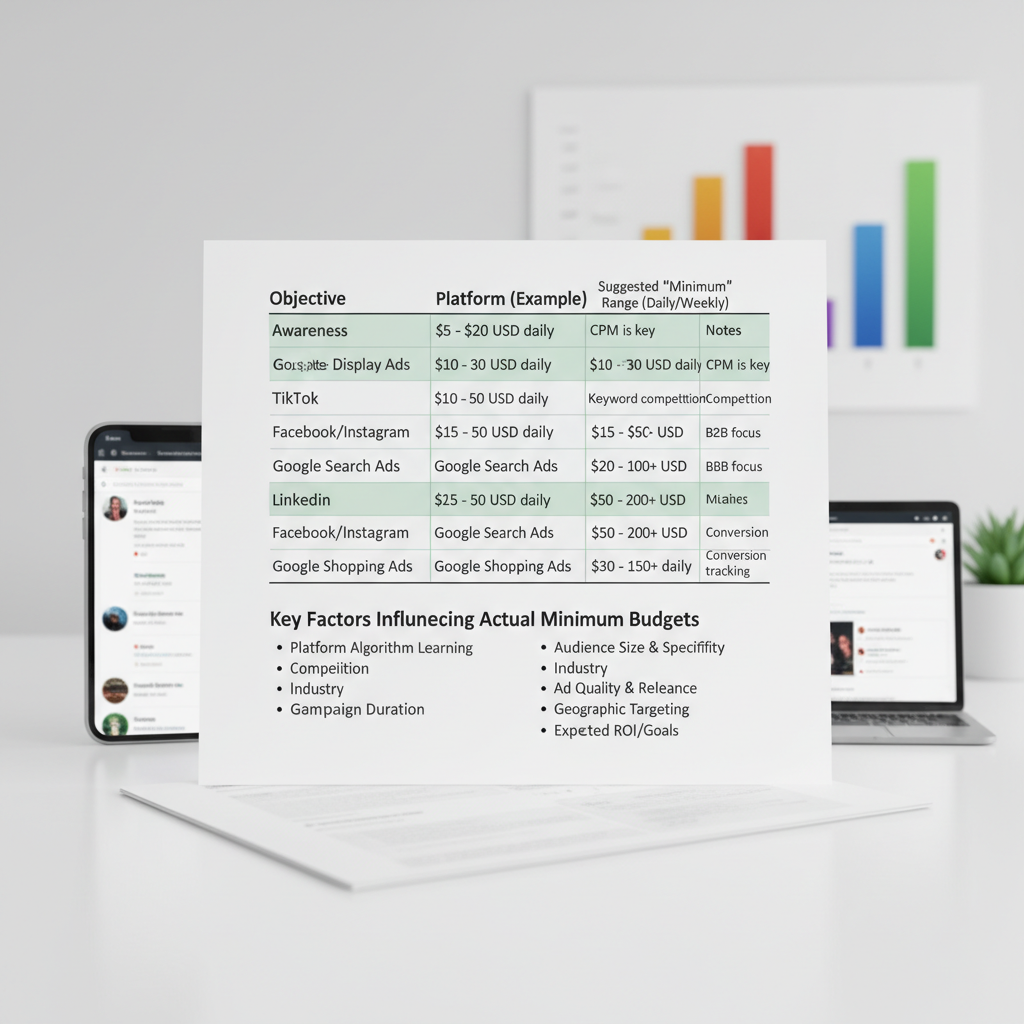
Understanding platform-specific minimums is crucial for setting realistic expectations and choosing where to start your advertising efforts.
Meta (Facebook & Instagram)Minimum daily budget per ad set: $5 (platform minimum)
Practical minimum for optimization: $20-25/day per ad set
Recommended starting budget: $50/day per campaign
Meta's algorithm needs approximately 50 conversion events per week per ad set to exit the learning phase and optimize effectively. Below this threshold, campaigns remain in perpetual learning, delivering inconsistent results.
With a 2% conversion rate and $20 CPM, you need roughly $25/day to generate 50 conversions per week. This explains why campaigns spending $5-10/day often underperform—they never accumulate enough conversion data for the algorithm to learn.
Google Ads (Search)Minimum daily budget: $10-15/day (practical minimum)
Recommended starting budget: $30-50/day per campaign
Optimal budget for Smart Bidding: $100+/day
Google Search campaigns need 30-50 conversions in 30 days to enable automated bidding strategies like Target CPA or Maximize Conversions. Below this threshold, you're limited to manual bidding, which requires more management time and expertise.
For competitive industries with higher CPCs ($5-15), the minimum budget to achieve sufficient click volume increases proportionally. A campaign in legal services or insurance may need $100-200/day to gather meaningful data.
Google Ads (Shopping)Minimum daily budget: $20-30/day
Recommended starting budget: $50-75/day
Optimal budget for Smart Shopping: $100+/day
Shopping campaigns distribute budget across your product catalog based on performance. Insufficient budget spreads too thin across products, preventing any single product from getting enough impressions to optimize.
A catalog with 100+ products needs higher minimum budgets than a focused catalog of 20-30 products.
Google Display & YouTubeMinimum daily budget: $10-15/day per campaign
Recommended starting budget: $25-40/day
Optimal budget for brand campaigns: $75+/day
Display and video campaigns have lower CPMs than search but require higher impression volume to drive meaningful conversions. The lower cost per impression means you need higher daily budgets to accumulate sufficient conversion data.
TikTok AdsMinimum daily budget: $20/day (platform minimum for most objectives)
Practical minimum for optimization: $50-75/day per campaign
Recommended starting budget: $100/day
TikTok's algorithm is particularly data-hungry and requires substantial initial spend to learn audience preferences and creative performance. Campaigns below $50/day often struggle to exit learning phase within a reasonable timeframe.
TikTok also has higher variance in performance compared to more mature platforms, making adequate budgets essential for getting past initial testing volatility.
LinkedIn AdsMinimum daily budget: $10/day (platform minimum)
Practical minimum: $50-75/day per campaign
Recommended for B2B: $100-150/day
LinkedIn has the highest CPMs of major platforms ($30-100+), making minimum budgets higher to achieve sufficient reach and frequency. B2B campaigns with narrow targeting need even higher budgets to overcome small audience sizes.
These minimums apply to individual campaigns or ad sets depending on platform structure. Running multiple campaigns or ad sets multiplies your required budget proportionally.
Use our Daily Budget Calculator to determine appropriate budgets based on your conversion goals and expected cost per conversion.
Why Platforms Need Minimum Spend
Understanding why minimum budgets exist helps you set realistic expectations and avoid common pitfalls of underfunded campaigns.
Algorithmic Learning RequirementsModern advertising platforms use machine learning to optimize delivery. These algorithms need statistically significant data to:
- Identify patterns in audience behavior
- Understand which creative resonates with which users
- Predict conversion probability for ad delivery
- Optimize bids in real-time auctions
Statistical significance requires volume. Meta explicitly states that ad sets need approximately 50 conversion events per week to exit learning phase. Below this threshold, the algorithm lacks sufficient signal to optimize effectively.
This creates a minimum budget threshold: Budget = (50 conversions/week) × (cost per conversion)
If your cost per conversion is $25, you need at least $1,250/week or roughly $180/day to feed the algorithm adequately. In practice, campaigns can run on less, but they'll take much longer to optimize and may never reach peak efficiency.
Auction DynamicsAd platforms use second-price auctions where your ad competes against others for limited inventory. Insufficient budget creates several problems:
- Budget exhaustion: Your budget depletes early in the day, preventing participation in higher-value auction opportunities later.
- Inconsistent delivery: Stop-start delivery patterns prevent algorithmic learning and reduce campaign quality scores.
- Limited testing: Insufficient budget prevents adequate creative and audience testing, forcing you to make optimization decisions on statistically insignificant data.
- Frequency issues: Low budgets may either under-deliver (missing opportunities) or over-deliver to tiny audiences (creating ad fatigue).
Effective advertising requires testing variations of creative, copy, audiences, and offers. Each test cell needs adequate budget to reach statistical significance.
A basic A/B test comparing two ad variations needs at least 100 conversions per variation to detect meaningful performance differences. If each conversion costs $20, you need $4,000 total budget—$2,000 per variation—to run one meaningful test.
Businesses trying to optimize on budgets below testing thresholds make changes based on noise rather than signal, often making performance worse rather than better.
Platform Minimums vs Practical MinimumsPlatforms set low official minimums to encourage adoption, but these minimums represent the floor to run, not the floor to succeed.
Meta allows $1/day campaigns, but this budget is functionally useless—it might generate 2-3 clicks and zero conversions. You'll learn nothing and waste money on insufficient data.
The gap between platform minimums and practical minimums catches many new advertisers who start campaigns that technically run but never have a realistic chance of success.
Single Platform vs Multi-Platform Minimums
Budget constraints force strategic decisions about platform focus. Spreading limited budgets across multiple platforms almost always performs worse than focusing resources on a single platform.
Single Platform Approach ($500-1500/month)If your total advertising budget is $500-1500/month ($17-50/day), focus entirely on one platform that best fits your business model:
Choose Meta if:- You have strong visual products
- Your target audience uses Facebook/Instagram heavily
- You need to build audience awareness
- You have good creative resources
- You have clear search intent for your product
- Your customers actively search for solutions
- You need high-intent traffic
- You can afford CPCs in your industry
- You sell products people search for by name or category
- You have competitive pricing
- You have a product catalog with good images
- You're in ecommerce
Running a single focused campaign on one platform for $50/day will dramatically outperform splitting that budget into $15/day on Meta, $20/day on Google Search, and $15/day on Google Shopping. The focused approach allows:
- Sufficient data for algorithmic optimization
- Ability to run meaningful tests
- Consistent campaign delivery
- Platform expertise development
At $1500-3000/month ($50-100/day), you can consider running two platforms, but maintain minimum thresholds:
Common successful combinations:- Meta ($30-40/day) + Google Search ($20-30/day)
- Google Search ($30-40/day) + Google Shopping ($20-30/day)
- Meta ($40-50/day) + Retargeting on both Meta and Google ($10-20/day combined)
The key principle: ensure each platform receives at least $20-25/day, which provides enough budget for basic optimization. If you can't maintain these minimums across two platforms, stick with one.
Multi-Platform Approach ($3000+/month)At $3000+/month ($100+/day), you can effectively run multiple platforms:
$3000/month ($100/day) sample allocation:- Meta prospecting: $40/day
- Google Search: $35/day
- Retargeting (Meta + Google): $25/day
- Meta prospecting: $75/day
- Google Search: $60/day
- Google Shopping: $40/day
- Retargeting: $25/day
- Meta prospecting: $120/day
- Google Search: $100/day
- Google Shopping: $60/day
- YouTube/Display: $30/day
- Retargeting: $23/day
Notice that even at higher budgets, retargeting receives relatively smaller absolute budgets because retargeting audiences are smaller and don't require the same budget levels to saturate available inventory.
Use our Budget Allocator to determine optimal distribution of your budget across platforms based on your specific goals and constraints.
Minimum Budgets by Campaign Objective
Different campaign objectives require different minimum budgets because they optimize for different actions at different costs and volumes.
Awareness Campaigns (Impressions/Reach)Minimum budget: $15-25/day
Recommended: $50+/day
Awareness campaigns have the lowest cost per result (impressions or reach) but need substantial volume to impact brand metrics meaningfully. A campaign reaching 5,000 people is unlikely to move the needle for most businesses.
To reach 50,000 unique users per month with 3-5 frequency, expect to spend $300-500/month minimum, or roughly $15-20/day.
Consideration Campaigns (Traffic/Engagement)Minimum budget: $20-30/day
Recommended: $50-75/day
Traffic and engagement campaigns need sufficient volume to identify which audiences are most engaged and likely to convert in future interactions. Landing page views, video views, or engagement events cost more than impressions but less than conversions.
Budget should generate at least 500-1000 engaged actions per week to feed optimization algorithms and build meaningful retargeting audiences.
Conversion Campaigns (Purchases/Leads)Minimum budget: $30-50/day per campaign
Recommended: $75-150/day
Conversion campaigns have the highest cost per result and need the most budget to gather optimization data. As discussed in platform minimums, you need roughly 50 conversions per week to optimize effectively.
Calculate your minimum budget as:
Minimum Budget = (50 conversions / 7 days) × Expected CPA = 7 × CPAIf you expect $20 CPA, your minimum budget is $140/day. If this exceeds your available budget, you may need to:
- Start with consideration campaigns and retarget engaged users
- Focus on lower-funnel campaigns with cheaper conversions
- Accept longer learning periods with lower budgets
- Choose platforms with lower conversion costs
Minimum budget: $10-15/day
Recommended: $20-30/day
Retargeting campaigns can operate on lower budgets because:
- Audiences are smaller, requiring less budget to saturate
- Conversion rates are higher, generating more conversion events per dollar
- Costs are lower due to higher relevance scores
However, retargeting budgets are constrained by available audience size. If you only have 1,000 website visitors per week, even a large retargeting budget won't spend fully.
Right-size retargeting budgets to your actual traffic:
- 1,000-5,000 visitors/week: $10-20/day retargeting budget
- 5,000-15,000 visitors/week: $20-40/day retargeting budget
- 15,000+ visitors/week: $40+/day retargeting budget
Small Budget Strategies ($500-$2000/month)
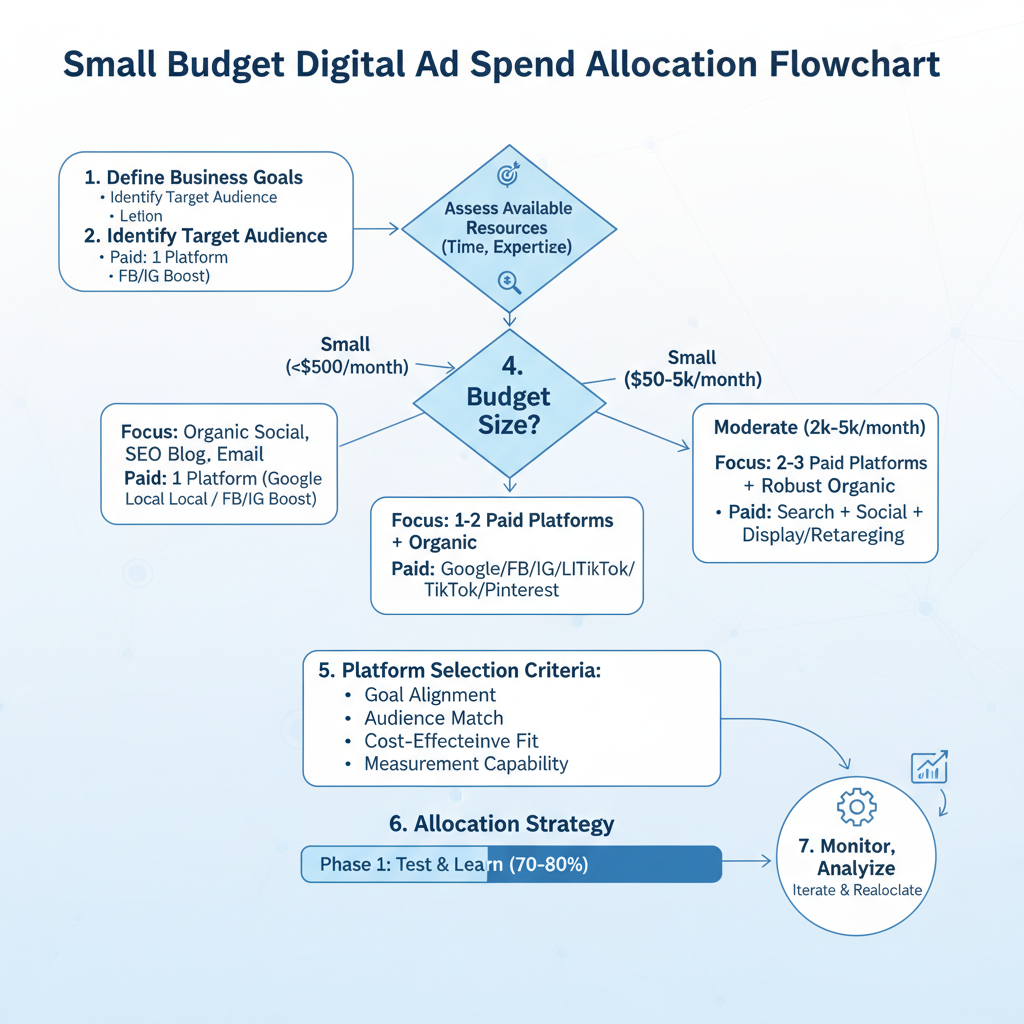
Limited budgets require strategic focus and realistic expectations. You can still run effective paid advertising at $500-2000/month, but success requires trade-offs and discipline.
Strategy 1: Single Platform FocusPick one platform that best fits your business and run focused campaigns:
$500/month ($17/day) approach:- Single campaign on best-fit platform
- One ad set targeting your core audience
- 3-4 ad variations for minimal testing
- Focus on optimization over expansion
This minimal budget won't trigger full algorithmic learning but can generate results if you:
- Target very specific, high-intent audiences
- Use proven creative formats
- Optimize manually based on performance data
- Accept longer timeframes to achieve results
- Single platform with potential for limited testing
- 2 ad sets or campaigns (prospecting + retargeting)
- 4-6 ad variations
- Some room for audience and creative testing
- Single platform with substantial testing capability, or
- Two platforms with minimal budgets on each
- Prospecting + retargeting strategy
- Monthly creative refreshes
- Basic A/B testing program
If conversion budgets are too high, run awareness or consideration campaigns to build audiences, then retarget them through organic channels:
- Run traffic campaigns at $20-30/day to drive website visitors
- Build email list through content offers
- Retarget website visitors through email nurture sequences
- Use organic social to stay top-of-mind with engaged audiences
This hybrid approach stretches paid budgets by using cheaper upper-funnel objectives while converting through owned channels.
Strategy 3: Seasonal ConcentrationInstead of spreading $1000/month year-round, concentrate budget in high-value periods:
- Save budget and run $3000-5000 campaigns during peak seasons
- Go dark in slow periods when conversion costs are prohibitive
- Build email lists during campaigns to maintain connection off-season
A holiday campaign at $5000/month for 2 months often outperforms $800/month year-round because it provides sufficient budget for proper optimization during high-intent periods.
Strategy 4: Retargeting-Only ApproachIf conversion campaign budgets are too high, focus exclusively on retargeting:
- Build traffic through SEO, content marketing, and organic social
- Run retargeting campaigns only at $500-1000/month
- Achieve higher ROAS from warm traffic while keeping costs manageable
Retargeting-only approaches work best for businesses with:
- Existing organic traffic sources
- Longer consideration cycles where multiple touchpoints matter
- Limited budgets that can't support cold prospecting at scale
- Focus beats distribution: Better to succeed on one platform than fail on three
- Quality over quantity: Better creative and targeting matter more with limited budgets
- Patience required: Small budgets take longer to optimize—expect 60-90 days for meaningful results
- Manual management: Can't rely on automation at low budgets—requires hands-on optimization
- Realistic expectations: Won't achieve the scale or efficiency of properly-funded campaigns
When to Scale Up from Minimum Budgets
Knowing when to increase budgets is as important as knowing minimums. Scale too early and you waste money. Scale too late and you miss growth opportunities.
Signal 1: Consistent Performance Above Break-EvenWhen campaigns consistently deliver ROAS above your break-even threshold for 2-3 weeks, you have evidence that increased budget can profitably scale.
Look for:
- Stable or improving ROAS week over week
- Cost per conversion remaining consistent or decreasing
- Conversion rates stable as spend increases
- No signs of audience saturation
When campaigns consistently exhaust budget before end of day, you're likely missing profitable opportunities.
Check:
- Campaign delivery reports showing "limited by budget"
- Impression share data showing lost impressions due to budget
- Hourly performance data showing strong performance that drops to zero when budget depletes
If campaigns are budget-constrained and performing well, increase budget by 20-50% and monitor for efficiency changes.
Signal 3: Maxed Out Current AudienceWhen performance plateaus due to audience saturation rather than budget constraints, you need different strategies:
- Expand to new but related audiences
- Test new platforms to reach audience members not on current platform
- Increase frequency caps if conversion rates remain strong
- Develop new creative to re-engage saturated audiences
Scaling budget into saturated audiences increases costs without increasing results.
Signal 4: Testing Validates New OpportunitiesWhen testing reveals winning new audiences, creative, or offers, scale budget to capitalize:
- New audience segment tests showing equal or better ROAS
- Creative variations significantly outperforming originals
- New product or offer launches showing strong early response
Scale budget into winners while reducing budget on losers.
How to Scale Safely: 20% Rule: Increase budgets by no more than 20% every 3-4 days to avoid triggering relearning periods that hurt performance. Test First: Before major budget increases, run small tests at higher spend levels to validate that efficiency holds. Monitor Closely: Watch efficiency metrics daily during scaling periods and pull back quickly if ROAS degrades significantly. Scale Best Performers: Increase budget on top-performing campaigns/ad sets rather than scaling underperformers. Prepare Creative: Have new creative ready to deploy as you scale to maintain freshness and avoid fatigue. Typical Scaling Path:Month 1: $1500-2000/month (testing and optimization)
Month 2-3: $2500-3500/month (scale winners, prune losers)
Month 4-6: $5000-7500/month (multi-platform expansion)
Month 7+: $10,000+/month (sustained scaling with continuous testing)
This progression assumes positive performance at each stage. If campaigns don't perform at minimal budgets, don't scale—fix fundamental issues first.
Budget Requirement Calculator
Use this framework to calculate your minimum budget requirements:
Step Determine Your Expected CPA
Research typical costs in your industry or use early campaign data:
Expected CPA: $______
Step Calculate Weekly Conversion Goal
For algorithmic optimization: 50 conversions/week
For basic performance: 20 conversions/week
Choose your goal: ______ conversions/week
Step Calculate Required Daily Budget
(Weekly Conversion Goal × Expected CPA) / 7 = Daily Budget
Example: (50 × $30) / 7 = $214/day
Your calculation: $______/day
Step Apply Platform Multipliers
If running multiple platforms or campaigns, multiply by number of campaigns:
- Single campaign: 1×
- 2 campaigns: 2×
- 3+ campaigns: 3×+
Your total budget requirement: $______/day
Step Reality Check
If calculated budget exceeds your available budget:
- Start with consideration campaigns (cheaper per conversion)
- Focus on retargeting only (smaller audience, lower budget needed)
- Choose one platform instead of multiple
- Accept longer learning periods with lower budgets
- Consider non-paid channels until budget allows proper paid advertising
For detailed budget allocation across platforms and campaign types, use our Budget Allocator to optimize your distribution.
Planning Your Starting Budget Strategically
Rather than starting with arbitrary budget numbers, work backward from your business goals to determine appropriate investment levels.
Goal-Based Budgeting Framework:Step Define Monthly Revenue Goal
Monthly revenue target from paid advertising: $______
Step Determine Target ROAS
Based on your profit margins and business model: ______ ROAS
Step Calculate Required Ad Spend
Revenue Goal / Target ROAS = Required Monthly Budget
Example: $30,000 revenue / 3.5 ROAS = $8,571/month
Your calculation: $______/month
Step Assess Feasibility
Can you afford this budget?
- Yes: Proceed with full budget
- No: Reduce revenue goal or find alternative channels
- Maybe: Start with minimum viable budget and scale as ROI proves out
If calculated budget exceeds capacity, determine minimum viable budget:
- Calculate conversions needed for revenue goal (Revenue / Average Order Value)
- Multiply by expected CPA to get minimum budget
- Add 20-30% buffer for testing and optimization
- If still too high, reduce revenue goal proportionally
Many businesses should plan budget ramps rather than static budgets:
Month 1: Testing budget (50% of calculated minimum)- Goal: Validate channel viability and gather data
- Focus: Testing audiences, creative, offers
- Goal: Optimize based on Month 1 learnings
- Focus: Scale winners, eliminate losers
- Goal: Achieve target ROAS at scale
- Focus: Sustained performance with continuous optimization
This approach reduces risk while providing adequate budget for learning at each stage.
Funding Your Ad Budget:If calculated minimum exceeds current capacity:
- Reallocate from less effective marketing channels
- Reduce product costs to improve margins and allow higher CPA
- Secure additional capital specifically for customer acquisition
- Start with organic channel development until paid budgets are viable
- Consider revenue-based financing where ad spend is funded from returns
The worst approach is starting with randomly chosen low budgets that provide no real chance of success. Either commit to realistic minimum budgets or invest in alternative channels until paid advertising is viable.
Your advertising budget isn't an expense—it's an investment in customer acquisition. Like all investments, there are minimum viable amounts below which returns are negligible. Understanding these minimums and planning accordingly is the difference between paid advertising that builds your business and paid advertising that drains resources without results.